Tuesday, June 30, 2009

The Debts of the Spenders: States Face Looming Budget Gaps

Chronic addicts to debt face imminent funding shortfalls.

States brace for shutdowns

Time is running out for the legislatures in Arizona, California, Indiana, Mississippi and Pennsylvania to solve budget gaps.
By P.J. Huffstutter and Nicholas Riccardi
June 30, 2009
Reporting from Indianapolis and Denver -- The last time Indiana missed its deadline for passing a budget and had to shut down the government was during the Civil War.

But on Monday, as lawmakers raced to hammer out an agreement over school funding, state agencies began preparing 31,000 workers to be temporarily out of a job. Republican Gov. Mitch Daniels has warned residents that most of the state's services -- including its parks, the Bureau of Motor Vehicles and state-regulated casinos -- would be shuttered unless a budget is passed today.

Indiana is one of five states -- along with Arizona, California, Mississippi and Pennsylvania -- bracing for possible shutdowns this week as time runs out for lawmakers to close billion-dollar gaps in their fiscal 2010 budgets.

Of the 46 states whose fiscal year ends today, 32 did not have budgets passed and approved by their governors as of Monday afternoon, according to the National Conference of State Legislatures.

http://www.latimes.com/news/
nationworld/nation/la-na-shutdown30-2009jun30,0,1912245.story

Monday, June 29, 2009

The Debts of the Spenders: CDS Case Law Update

I wrote here about a month ago promising that I would start including some CDS case law coverage about the securitization industry. Case law remains a bit scant but there are a variety of interesting issues that have already been ruled on such as ownership of notes and mortgages.

Since I no longer have reliable access to Westlaw or Lexisnexis, I have to dig through older law periodicals or ask others for help in providing case names.


Here is one interesting tidbit - In re Foreclosure Cases, 2007 WL 3232420.

Although it is a bit dated (from 2007), the case should still be controlling.

After reading the case though, it seems that the court ruled on narrow and specific terms - specifically on the issue of the lenders recording the deeds ONLY AFTER the case had been filed in court. So, that is an error that can be easily cured depending on whether or not the property is situated in a race notice or notice recording state. The UCC (Uniform Commercial Code) would also seems to support the lenders' contentions as there are provisions w/in that make for a strong lender argument.

See:

http://www.abanet.org/rppt/publications/
ereport/2007/6/OhioForeclosureCases.pdf

For the actual decision

http://www.consumerwarningnetwork.com/wp-content/
uploads/2008/06/judge-boyko-ruling1.pdf

*Thanks Robert for the case name*

The Debts of the Spenders: Drought in Canada?

This information did not seem to affect commercials last week as they were net short the softs and grains on June 26th. Still, it is something to be mindful of going into the latter part of this summer and early fall as govt agencies re-assess potential crop yields for the harvest.

“The hills look like sawdust, really, that colour,” he said from his ranch, a short drive from Elnora, Alta. “I've never seen it where the grass didn't turn green in the spring before.”

He normally turns his 50 cow-calf pairs loose to graze in the first week of May. This year, he's still feeding them what hay he can find – much of it poor quality, all of it expensive. It costs him more than twice as much to feed hay as to rent grazing land.

Farmers and ranchers across a vast section of Alberta and Saskatchewan are staring down the same ominous fields of parched soil and brown crops.


http://www.theglobeandmail.com/news/national/
alarm-bells-ring-on-drought-disaster/article1188142/

The Debts of the Lenders: Putin Closes All Casinos In Russia

In the 1990s and even early 2000's, Russia and the rest of the CIS was renowned for casino capitalism - literally. Shady characters dressed in track jumpsuits, gold chains, and designer sunglasses used to run the economy. But no more. Or at least not openly.

Putin has decided to return to the old days of the Soviet era by banning gambling. But in the process, he is also throwing a disruptive wrench in the economy. The NY Times predicts that thousands of people will be laid off as a result of the new laws.

A government loophole that legalizes gambling in the more remote reaches of the vast Russian landscape is not doing much to assuage workers and customers alike. It is unlikely that travelers would journey to the Russian Far East or somewhere else equally distant.

Like in the days of Dostoyevsky, gambling will simply revert to its primal roots as an underground activity.

Sources:

http://www.kremlin.ru/eng/speeches/2009/05/05/2019_type82913_215874.shtml

http://www.nytimes.com/2009/06/29/world/europe/29casinos.html?_r=1&hp

Sunday, June 28, 2009

The Debts of the Lenders: Hong Kong Slashes Mortgage Rates to Lowest in 19 Years

Hong Kong is notorious for having some of the most overpriced property in the planet. But apparently, policy makers are intent on re-inflating the bubble again. Perhaps they should read an economic textbook or better yet, apply some common sense and realize that not everyone is able to afford a home. Home ownership is a privilege - not a right. If you are too poor to afford an apartment or house, then rent.

I find the last paragraph particularly amusing (emphasis my own).

Mortgage rates in the city are the lowest in at least 19 years, as far back as records are available, to offset slower demand for other types of credit during Hong Kong’s worst recession in a decade. Among developed economies, only Japan offers similarly cheap loans, as its central bank has kept interest rates below 1 percent for the past 14 years, said Leland Sun, founder of Pan Asian Mortgage Co.

“Hong Kong banks are killing themselves with the low rates,” said Sun, whose Hong Kong-based firm advises homebuyers.

“With these kinds of mortgage rates, banks aren’t really making much money,” said Dominic Chan, a Hong Kong-based analyst at BNP Paribas Securities Asia Ltd. “But for them it’s probably still better than putting money in, say, U.S. Treasury notes.”

Source: http://www.bloomberg.com/apps/
news?pid=20601087&sid=aBCwwJZQZqaI

The Debts of the Spenders: Primary Dealers, the Non-Agency Market, and Treasuries

I was doing some weekend reading and came across this insightful piece from Zero Hedge as featured on Naked Capitalism. ZH's article goes a great way towards explaining the recent bond market's wild moves, including the preceding post about Dresdner Kleinwort.

The key takeaway here is the 3 year period. . . .which would put us sometime in 2012 when things collapse. Mayan prophecy anyone?

Primary Dealers are selling corporates in droves in order to purchase Treasuries and MBS under the Fed's gun. Primary Dealers now have a record $368 billion in Corporate, Agency, MBS and Treasury inventory. And the vast bulk of PD holdings of agency debt has less than a 3 year maturity.

The Fed has bought $103 billion in Agencies, almost half of which matures in the next 3 years. Amusingly, the roll coincides when roughly $1 trillion of CRE debt comes due. Good luck.

The Fed has bought $103 billion in Agencies, almost half of which matures in the next 3 years. Amusingly, the roll coincides when roughly $1 trillion of CRE debt comes due. Good luck.

http://www.nakedcapitalism.com/2009/06/
guest-post-collapse-of-non-backstopped.html

Saturday, June 27, 2009

The Debts of the Spenders: Dresdner Kleinwort Dropped From Primary Dealer List

Supply meets Demand. The Feds are suffering from a SLIGHT case of indigestion. And it's affecting the primary dealers - a cartel of large investment banks that basically get a license to make money by re-selling US debt at markups (a privileged spread trade w/the Fed).

The problem of course, arrives when the dealers need to bid to meet the demand.

June 26 (Bloomberg) -- Dresdner Kleinwort Securities LLC dropped from the ranks of securities firms that trade Treasuries with the Federal Reserve, bringing the dealer network back to the smallest in the 49-year history of the system.

Dresdner is the second dealer this year to resign from the network of firms which was formalized by the Fed in 1960. The dealers are mandated to bid at Treasury auctions and that act as counterparties for the central bank as it conducts open-market operations. At 16 firms, the number of dealers is less than the original 18.


Thursday, June 25, 2009

The Debts of the Lenders: China Expands Global Reach to Iraqi Oil Fields

After getting stiffed in 2003 and losing its existing deal(s) w/Saddam Hussein, China is back in Iraq. Well, at least through a backdoor. Sinopec recently bought Addax Petroleum, a Swiss energy company w/concessions in Iraq's Kurdistan region (supposedly one of the "safer" regions of Iraq).

Such an acquisition meshes well w/China's overall goal of achieving more reliable energy supplies. Since they are working in an American controlled region of the world, China has suddenly become a lot "friendlier" lately in its international relations. Instead of issuing bombastic attacks that question the value of the US dollar and treasury market, recent language has become a lot more subdued.

Subtle clues were issued at the end of the Shanghai Cooperation Organization's meeting earlier this month when the Russian-Chinese sponsors decided to tone down their criticisms of dollar hegemony by reiterating the continued importance of the greenback in the international economy.


China firm gains Iraq, Africa oil

China's second-biggest oil company has gained reserves in Iraq and Africa after agreeing a record-breaking merger with a Swiss oil explorer.

Sinopec, a subsidiary of China Petrochemical Corporation -Asia's largest oil refiner -agreed to pay $7.2bn for Geneva-based Addax Petroleum Corp in its biggest overseas acquisition to date.

Sinopec said in a statement the deal was a "transformational transaction" which would "further enable it to achieve its strategic objective to build a stronger presence and operations" in West Africa and Iraq.

The purchase of Addax is part of China's efforts to secure energy reserves to fuel its growing economy.


http://english.aljazeera.net/news/asia-pacific/
2009/06/20096258127542668.html

Wednesday, June 24, 2009

The Debts of the Lenders: Indian Monsoon Season Seen as Below Normal

Good news for sugar bulls - but not by much. The sub-continent is facing as much as a 2 week lull in wet weather. There is more spillover effect in the planting season for other crops such as soybeans (which is negligible compared to S. American production), cotton, and rice - although the Indian ministry denies that it will have much effect.

India 2009 Monsoon Rains Seen Below Normal-Govt

India’s monsoon rains this year will be below normal, around 93% of the longterm average, which is lower than the previous forecast, Science and Technology Minister Prithviraj Chavan said Wednesday.

He added that the monsoon rains in July will be 93% of the long-term average for the month, while rains in August are estimated to be just above the average. The four-month monsoon, crucial for crops such as rice, wheat, sugarcane, oilseeds and cotton, was 53% lower between June 1 and 23 compared with the average for the same period a year ago. About 60% of the crops in India are rain-fed.

The predictions for long-term average rainfall have an error margin of 4%, Chavan said.

The long-term average rainfall, referred to by the federal government, is 89 centimeters
over the country as a whole for 1941-1990.

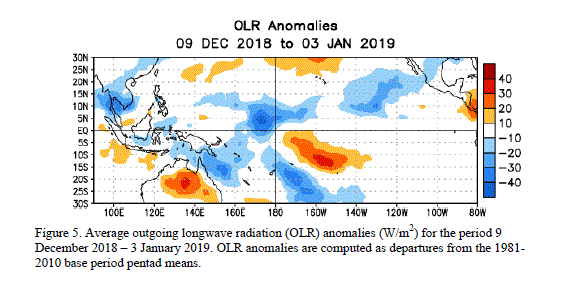
“There is a high probability of El Nino conditions to prevail during monsoon,” Chavan told reporters. The probability of El Nino has been estimated at 60%. El Nino, which is said to have impacted on the progress and distribution of rainfall in India, is the abnormal warming of the surface ocean water in tropical Pacific.

“This month El Nino conditions became evident, which were not visible in April and May,” Chavan said. In April, the India Meteorological Department, or IMD, had forecast near-normal rainfall of 96% of the long-term average. Based on historical data, the IMD has ruled out the possibility of excess rainfall during the monsoon.

There are some signals of revival of the monsoon due to a likely development of a monsoon surge over the Bay of Bengal during the last week of June, the department said. It said the active phase of the monsoon is likely to continue during the first half of July, leading to the advance of the monsoon over many parts of northwest India.

Source: CME News for Tomorrow

The Debts of the Spenders: CFTC and Senate Target Wheat Speculators

Gee. I thought this story looked familiar. Similar concerns were being raised LAST YEAR around the same time. To be fair, the CFTC and legislators do have legitimate concerns as many market participants aside from traders actually were forced out of b/c of high prices.

Even during the darkest days for the ag bulls (the October - December period 2008), commercials remained leery of going long to hedge their costs. As a result, bakers and other food industry groups suffered higher costs. Their belated reluctance to enter the market during the spring growing season is hampering costs AGAIN b/c of another factor - the poor weather.

I believe that commodity prices are unlikely to return to 2008 levels b/c of the Fed and other central banks talking down commodities. Deflation remains a significant factor in the macro picture. So far, this year's rise in agriculture prices is more a combination of poor weather and inflation expectations built on the back of Chinese stockpiling.

WSJ(6/24)UPDATE: Commodities: Panel Targets Wheat Speculators
(From THE WALL STREET JOURNAL) By Bill Tomson

Speculation in wheat futures by commodity index traders, who control billions of dollars worth of contracts, is ruining the price-hedging system used by the farm sector and could translate into higher prices for food manufacturers and consumers, a Senate panel said in a report released Tuesday.

The Senate's Permanent Subcommittee on Investigations conducted a yearlong probe of the wheat market and suggested in a 247-page report that new limits are needed for index traders, and a government regulator said the situation warranted a "fresh" review.

The report and the subcommittee's chairman, Sen. Carl Levin (D, Mich.), blame the Commodity Futures Trading Commission for facilitating the index traders by allowing some to go well beyond normal buying limits. The CFTC is the regulatory agency charged with overseeing futures markets.

"The CFTC helped create the problem by allowing some index traders to exceed the standard limit on the number of wheat contracts that traders are supposed to be able to hold at any one time," Mr. Levin said.

Traders are supposed to be limited to holding 6,500 wheat future contracts, but the CFTC has granted several exemptions and "no-action" letters that allow traders to go well above the limit -- up to 53,000 contracts, in one instance.

"Together these hedge exemptions and no-action letters permit six index traders to hold a total of up to 130,000 wheat futures contracts at any one time," the report said. "CFTC data indicates that, from 2006 to mid-2008, the total number of outstanding contracts . . . attributable to commodity index traders in the wheat market was about 200,000 contracts. That means that the six index traders granted waivers from trading limits may have held up to about 60% of all the outstanding wheat contracts held by index traders."

The value of the investments in commodity indexes "has increased an estimated tenfold in five years," according to the report, "from an estimated $15 billion in 2003 to around $200 billion by mid-2008."

Bart Chilton, a CFTC commissioner, said Tuesday he has had his own concerns about the detrimental effect of "excessive speculation" and called the exemptions "questionable" and deserving "a fresh review by the commission."

Heavy buying by index funds that only take long positions -- essentially bets that prices will
move higher -- are "at least in part responsible for higher wheat prices and the 'lack of convergence' between futures and spot prices at the expiration of contracts," Mr. Chilton said.

The long-only stance of index traders is unlike the behavior of other market participants, who follow market trends and alternate between long positions or short positions, which are expectations prices will decline. "This is a concern because it creates uncertainty in the marketplace and undermines the price discovery process," Mr. Chilton said.

In addition to CBOT, a subsidiary of the CME Group Inc., wheat futures are also traded on the Kansas City Board of Trade and the Minneapolis Grain Exchange.
The problem caused by index traders became particularly exaggerated last year when futures prices were more than $2 per bushel higher than cash prices during "convergence," the time when futures go into delivery and futures prices and cash prices are supposed to come together in order to facilitate hedging.

"The futures price became disconnected from the cash price, staying far higher than the cash price due to the index traders," Mr. Levin said.
Mr. Levin said Tuesday the index traders must be reigned in to bring back harmony to the system that was originally meant to help farmers, grain warehousers, and food producers hedge crop prices.

The Debts of the Spenders: The California Muni Situation

The California situation exposed from Accrued Interest:

In terms of California bond holders actually missing a payment, those odds are remote. S&P points out in their report coinciding with putting CA on negative watch:

An austere analysis of the state's ultimate capacity, from a budgetary perspective, to service its debt suggests to us that at $35.97 billion, constitutionally required spending on education (Proposition 98 expenditures) for 2010 leaves $53.15 billion in resources available for debt service (estimated at $5.74 billion) on general obligation and lease revenue bonds.

So if it came down the state actually running out of cash, first certain education spending would be met, then bond holders. On that basis, there is plenty of coverage. I think this leaves the likelihood of a payment completely missed as extremely low.

Now a payment delayed is a different matter. If the legislature were to not pass a budget by June 30, the state wouldn't be able to sell short-term notes to restock their checking account. At that point, I really don't know what the protocol would be. If, in theory, the state literally ran out of money, they obviously couldn't forward coupon payments on to bond holders. This would be a form of default. But of course, bond holders would eventually get their payments, most likely when the next quarterly payments were made by tax payers.

http://accruedint.blogspot.com/2009/06/
california-munis-what-is-it-some-kind.html

The Debts of the World: OECD Issues Mixed Signals In Latest Report

So which is it? Do we have economic growth, decline, or stagnation? Apparently, traders and economists both remain confused about the world outlook. One important thing to take out of this is the OECD's prediction of $50/barrel oil. This is FAR BELOW the current trading range - but well above the deflationary lows seen earlier this year in February-March.

Additionally, low oil prices will be a MAJOR FACTOR in fostering political volatility in oil producing states such as Iran and Venezuela that derive much of their public budgets from exporting crude. In order to make up the shortfalls, these states have to either a) cut politically popular entitlement programs (like food and energy subsidies); b) borrow more money; and/or c) print more money.

None of these choices is particularly attractive. A silver lining in the cloud is that a stronger $USD will make exports more attractive again. But, caution must be exercised as TOO STRONG a dollar will make existing loan repayments prohibitively expensive - as was demonstrated all too painfully last October-November.

Economic Outlook: The OECD effect

Jun 24, 2009 (UPI via COMTEX) --

A stomach-punching World Bank report this week was followed by a pat-on-the-back report from Paris that said stimulus spending was taking effect.

The Organization for Economic Co-operation and Development's semiannual economic forecast upgraded its March prediction of a 4.3 percent contraction this year to 4.1 percent decline, while 2010 would see a 0.7 percent growth rate, a step up from its previous prediction of a 0.1 percent decline.

Two days after the World Bank said global output would decline 2.9 percent this year, OECD -- with a focus on 30 developed nations including Germany, Britain, Japan, Canada, Spain and Australia -- said conditions had improved, especially in the United States and China, where monetary policy shifts were backed with large stimulus sending packages.

"Thanks to firm action to stimulate our economies, it appears that we have escaped the worst during this crisis," said OECD Secretary-General Angel Gurria, who added himself to the list of economic leaders calling for a "clear and credible plan" for policy shifts for "phasing out emergency measures as recovery takes hold."

"A recovery already appears to be taking hold in China," where growth is expected to hit 7.7 percent this year, the report said. In the United States, a 4 percent drop for 2009 was revised to a decline of 2.8 percent. In Europe, "signs of recovery are not yet clearly visible," OECD reported, projecting the euro area would see output decline 4 percent in 2009 and break even next year. In Japan, "there are signs that the slowdown triggered by the collapse in trade is coming to an end but the recovery will be slow."

Japan's economy was predicted to fall 6.8 percent this year, but return to 0.7 percent growth next year.

Holding up those numbers, the OECD said crude oil prices were likely to average about $55 per barrel this year and suggested home prices were still elevated in many countries, The New York Times reported Wednesday.

The Debts of the Lenders: Japanese Exports Collapse

Govt attempts to pump the Nikkei by issuing rosy interpretations of grim data are meeting stiff challenges. Insiders speak of large sell blocks around the 9k-11k levels. As an export oriented nation, Japan also needs a cheaper yen. But the macro story speaks otherwise.

Although the yen has weakened significantly since early February, it has since retraced and is making headway into a potentially bullish consolidation longer term. Forex analysts speak of the yen strengthening to as much as 90 against the dollar although it is likely that the BOJ will intervene around the psychologically important 95 level.

=DJ 2nd UPDATE: Japan May Exports Fall Sharply; Optimism Intact

(Adds comments from BOJ Gov. Shirakawa)

By Takashi Nakamichi OF DOW JONES NEWSWIRES

TOKYO (Dow Jones)--Japanese exports fell slightly more sharply in May than in the previous month on sluggish demand for cars, steel and electronic parts, but economists maintained that sales of Japanese goods overseas remain in a recovery trend.

The value of exported goods dropped 40.9% on the year in May, sharper than April's 39.1% fall and marking the eighth straight month of declines, data released Wednesday by the Finance Ministry showed.

Japan's merchandize trade surplus - the margin by which exports exceed imports - slid 12.1% on the year to stand at Y299.8 billion in May. But the figure was the largest in a year, and beat economists' forecasts of a Y214.6 billion surplus.

During May, exports of automobiles decreased by 60.9%, steel by 49.5% and electronic parts such as computer chips fell 33.5%, according to the data. Shipments to the U.S., Asia and the European Union all slipped.

The latest figures come after the pace of the decline in exports slowed successively in March and April, following February's record drop of 49.4%.

Still, economists warned against undue pessimism.

Last May had two fewer business days than the same month a year earlier, making the decline inevitable to some extent, they said. The value of total exports was in fact down only 0.3% from April when adjusted for seasonal factors, they said.

Moreover, overseas companies that have cleared their shelves are expected to resume buying Japanese goods as they restock, they added.

Bank of Japan Gov. Masaaki Shirakawa said Wednesday that the country's exports are gradually "turning around", while Japan's broader economy is bottoming out.

"Worldwide inventory adjustments have almost run their course, so we should see a clear improvement in exports during the April-June quarter," said Toshihiro Nagahama, chief economist at Dai-Ichi Life Research Institute. Stimulus steps taken by overseas governments are also expected to benefit Japan's exports by lifting demand abroad, he said.

Any pickup in foreign demand would be great news for an export-reliant Japanese economy that is trying to crawl out of its worst recession since World War II.

Yet, the longer-term prospects of exports remain murky, said Azusa Kato, an economist at BNP Paribas. Given continued weakness in global consumer demand, Japanese exports could face another phase of weakness "once the effects of stimulus action (by overseas governments) fade away and foreign firms finish rebuilding inventories," she said.

Some analysts, meanwhile, have been looking for any signs that Beijing's recent "buy China" directive for local government procurement is having any impact on Japanese trade. But even though Japan's exports to China fell 29.7% in May, a Japanese finance ministry official said it is hard to tell yet whether the decline had anything to do with the Chinese policy.

The value of imports fell 42.4% on the year in May, the data showed, a larger fall than in April and the seventh straight month of decline. Imports of crude oil fell by 63.1%, nonferrous metals by 74.7% and liquid natural gas by 51.4%, according to the data.

Whether the sliding imports spell trouble, however, is open to debate.
BNP Paribas' Kato took that as evidence of lackluster domestic demand. But Dai-Ichi Life Research Institute's Nagahama argued otherwise, saying a combination of improving exports and falling imports is a positive pattern often seen when the economy is emerging from a slump.

Tuesday, June 23, 2009

The Debts of the Spenders: Chris Whalen Exposes the CDS Cartel Before Congress

From Karl Denniger, sleuth extraordinaire and all around market sceptic. In these days, we need people like him. Please note that all opinions expressed below are Karl's or derivatives of Christopher Whalen.


If you haven't seen this, you need to.

Christopher Whalen is a principal of a firm that rates the performance of commercial banks, Institutional Risk Analytics. I have featured some of his writing before in Tickers, but this one, submitted to The Senate Committee on Banking, Housing and Urban Affairs yesterday, takes the cake. You must read this in full but for those who are incapable of understanding it, I'll spell out details for you. Some excerpts:

Simply stated, the supra-normal returns paid to the dealers in the closed OTC derivatives market are effectively a tax on other market participants, especially investors who trade on open, public exchanges and markets. The deliberate inefficiency of the OTC derivatives market results in a dedicated tax or subsidy meant to benefit one class of financial institutions, namely the largest OTC dealer banks, at the expense of other market participants.

Translated: The banks make extra-large profits by extracting money from other people in the rest of the market. That is, they have effectively been given the power to levy a tax - something supposedly reserved to Congress.

The taxpayers in the industrial nations also pay a tax through periodic losses to the system caused by the failure of the victims of OTC derivatives and complex structured assets such as AIGs and Citigroup (NYSE:C).

Worse, when they blow it, you eat it, not they. Why? Because they have effectively bribed the regulators to speak on their behalf and for their interests, much as allegedly happened with Stanford and the so-called Antiguan banking regulator.

With CDS and more obscure types of CDOs and other complex mortgage and loan securitizations, however, the basis of the derivative is non-existent or difficult/expensive to observe and calculate, thus the creators of these instruments in the dealer community employ "models" that purport to price these derivatives. The buyer of CDS or CDOs has no access to such models and thus really has no idea whatsoever how the dealer valued the OTC derivative. More, the models employed by the dealers are almost always and uniformly wrong, and are thus completely useless to value the CDS or CDO. The results of this unfair, deceptive market are visible for all to see – and yet the large dealers, including JPM, BAC and GS continue to lobby the Congress to preserve the CDS and CDO markets in their current speculative form.4


http://market-ticker.denninger.net/archives/
1149-Congress-Has-No-More-Excuses.html

http://www.rcwhalen.com/pdf/
StatementbyChristopherWhalen_SBC_062209.pdf

The Debts of the Spenders: Soybean Rust Fungus and Chinese Demand Compete for Volatile Trading

Early-mid July is cyclically and historically a very bullish period for soybeans. Add the Chinese comments and you have a you have a volatile situation.

Soybean Rust Seen As Far Greater Threat To 2009 US Crop

Delayed plantings and heavy spring rains have put much of the U.S. soybean
crop at an unusually high risk of damage from Asian soybean rust, a yield-robbing
fungus that has already begun to infect soybeans weeks earlier than ever before.

“These early finds mean that soybean rust could be a real threat to the soybean
crop, if the disease continues to progress,” said Iowa State University plant pathologist
Daren Mueller.

Thus far in 2009, soybean rust has been found in 23 counties of Alabama,
Florida, Georgia, Louisiana and Texas. It infected a record 392 counties across 16
U.S. states in 2008, but caused little yield damage because the disease developed late
in the growing season.

“This can be a devastating plant disease. Yield losses of 40-50% are possible in
soybeans when the disease invades a field early...and no fungicides are used to prevent
spread of the pathogen,” warned Alabama plant pathologist Ed Sikora, after the
disease was found in an Alabama soybean plot June 8. The Alabama discovery
occurred seven weeks earlier than in 2008.

This year, in addition to developing sooner, the disease is also targeting a soybean
crop that was planted later than normal, providing the pathogen an even greater
window of opportunity. The U.S. Department of Agriculture said Monday only 91%
of all intended soybean acreage had actually been seeded as of June 21, compared to
the seasonal average of 95%.

Source: CME News For Tomorrow
*****************************************************************

China Revises Down Jun Soybean Imports Estimate To 4.3M Tons

China’s Ministry of Commerce revised downward its estimate of soybean imports in June to 4.34 million metric tons from 4.617 million tons, a report on the ministry’s Web site said Tuesday.
Despite the revision, June soybean imports were still at a record monthly high. High volumes of recent soybean imports have sparked fears among market participants that supply will begin to pressure soybean prices.

China imported 3.52 million tons of soybeans in May, up 1.2% on year.

Source: CME News For Tomorrow

Monday, June 22, 2009

The Debts of the Lenders: Chinese Reality Check

From the inimitable Zero Hedge. Be sure to read some of the comments.

Here are a few highlights:


Nemo Incognito: "Tyler, you can buy CDS on Chinese real estate companies in reasonable size. Or, if you think RE will collapse then just short commodities - the commodities hit the wall shortly after China real estate did in 07-early 08.

Or, if you're really lazy (and like macro) just short asia itraxx High Yield. The beauty of shorting credit is that when the sh!t hits the fan the foreign creditors get paid peanuts if at all. Also, your downside is somewhat capped. Shorting equities is hard - lots of pump priming going on and i'd wait for the credit market to turn first."

Walkingshadow: "I am the author, and if I had to predict, I would bet that China will experience civil war within 5-10 years, not 25 years. Most likely closer to 5 years than 10. That's plenty of time to see things completely unravel there, for the Chinese to completely lose faith in their version of the "American Dream," and for the appearance of some charismatic leader who promises to right their many wrongs. The supreme irony of China today is that the Chinese Communist Party have conspired with the Chinese people, and together, this "Communist" country has somehow managed to create the very conditions that inspired Karl Marx to write the "Communist Manifesto" in the first place. If Lenin, Trotsky, and Marx were alive today, they would single out China as the most important place to foment a communist revolution."

Yes, aside from select residences in the best parts of Shanghai and Beijing and a very few other places, if most Americans saw the quality of "houses" that abound in China they would be appalled. Most of them look like ghettos, or worse. I don't think they have any idea what "paint" is. I can't recall ever seeing anybody paint anything in China, other than something that was being newly completed. But, I suppose they figure "why paint something that is crap in the first place?"

I've seen first-hand how the govt. "gently prods" peasants here and there. I was in Beijing when a few million were being summarily ejected from the city prior to the Olympics, so the Western press would not see what average Chinese people really look and act like, and wouldn't see how they are treated----worse than dogs, if you ask me.


CT: "This is one of the most ridiculous articles I've ever read. I really thought you had higher standards than this, Tyler. Might've seen this kind of analysis on a Yahoo board.

I can only hope the earlier poster is right, and the mention of Rogers as some sort of anonymous "hedge fund whiz" is just a poor joke.

This line is also representative of the very limited intelligence and insight shared by the author: "I think you’ll see people walking away from mortgages, just like you do everywhere else, except the scale will be massively increased because much of the property is unoccupied, and cannot be sold very easily, except perhaps at a deep discount."

Sounds like the author is unaware that:

- Chinese residential real estate has extremely tight standards on LTV (especially on second/third/investment homes), which are age dependent. A "typical" family that's purchased a home in the past 3-4 years will own 40-50% equity in the property.

- Chinese mortgages *are* recourse loans, and there is no Chinese law allowing personal bankruptcy (which would allow such mortgages to be discharged).

So, why doesn't the author take a shot at re-analyzing the situation with the two above facts in mind."


Source: http://zerohedge.blogspot.com/2009/06/
guest-post-china-economic-catastrophe.html

Saturday, June 20, 2009

The Debts of the Spenders: Eurodollar Futures Reminder

Just a reminder:

ED Futures are based off the following formula:

Price = 100 (1 – r)

For example, if a Eurodollar future is quoted at 99.25, this corresponds to an interest rate of .75%. (Anything <1% is effectively ZIRP)

Each .01 unit of price corresponds to a basis point, but it is called a tick.

Why it is important:

Eurodollar futures are HEDGES for fixed income and ESPECIALLY fixed income derivatives:

Ahem, can you say CDS, CLO, and other ABS junk?

When you see the contracts move down, that means the banks (most traders are bankers) are predicting HIGHER INTEREST rates and therefore WIDER spreads on the basis pt yields on the CMBX and CDX indices. Translation - LOWER prices for commercial real estate REITS and corporate/foreign bonds.

The thing I like about ED futures is that they are EXCHANGE TRADED - e.g. no shady OTC activity going on. Moreover, the ED futures market is one of the most liquid in the world (compare this to the Fed Funds rate). In fact, their very existence was formed as an alternative to the old practice of negotiating forward swap rates in bilateral contracts. That method took time and the buyer had to navigate a wide bid-ask spread (similar to what the ABS traders do today on their Bloomberg terminals). But in the old days, they had to use WATSON and wire requests.

Now, traders have the advantage of being able to look up where the market believes interest rates are headed in the next few days/weeks/months ahead anytime they want (either on exchange hours or through the Globex CME platform).

Disclosure - No position in ED futures. I simply use it as an analytical tool for watching greater market patterns.

Friday, June 19, 2009

The Debts of the Spenders: Libor, (Euro)Dollar, and Gold

*UPDATE - Corrections made.

The war between deflationists and inflationists is finding a new battlefield in the LIBOR markets. LIBOR is the rate that banks charge each other for overnight or shorter term (typically dollar) loans. The Eurodollar futures contract as traded on the CME/CBOT is based off a 3 month Eurodollar $1 million deposit and are bets on which way the LIBOR's BBA (British Bankers Association) council will vote.*

A higher LIBOR is indicative of an aversion to risk taking and a higher, projected borrowing costs (e.g. higher interest rates). LIBOR is set by a council of member banks as determined by the BBA. Recently, the BBA has decided to open the LIBOR process to a bigger group of banks.

The other way to predict future interest rates is to look at the Fed Funds market (which is ALSO traded on CME/CBOT). But that market has its own problems. Fed funds options are still predicting - more or less - continued low interest rates. This Fed funds action flies in the face of recent bond market moves by the vigilantes who are either selling their long bond positions or short selling treasuries to drive yields higher.

Both markets have their (dis)advantages. Normally, the spread or difference between LIBOR and Fed Funds is not that great but when you start to see a widening then there is cause for potential alarm. And the greatest threat that sets the large banks would be a bond market dislocation where bonds are no longer considered a flight to safety.

So, the question is: where would the liquidity flow from and to? The answer is most certainly going to include an exit FROM equities, commodities, and fixed income (including treasuries). The next step is where deflationists and inflationists diverge. Deflationists believe that higher LIBOR would mean a flight to safety to the dollar and yen. Inflationists believe that the funds will go to precious metals. I have a strong deflationist bias myself. After all, paper currencies - for all their flaws - are liquid mediums of exchange. You can buy food and transportation w/paper money. The same cannot be said for gold bars.

*Trade Unit:
Eurodollar Time Deposit having a principal value of $1,000,000 with a three-month maturity.

Point Descriptions:
1 point = .01 = $25.00

Contract Listing:
Mar, Jun, Sep, Dec, Forty months in the March quarterly cycle, and the four nearest serial contract months.

Product Code:
Clearing=ED
Ticker=ED
GLOBEX=GE

Trading Venue: Floor

Hours: 7:20 a.m.-2:00 p.m.Holidays LTD(Monday 5:00 a.m.)

Minimum Fluctuation:
Regular 0.01=$25.00
Half Tick 0.005=$12.50
Quarter 0.0025=$6.25 for nearest expiring month.

The Debts of the Lenders: J-Reits to Surface (Again)

Wait. I remember this happening circa . . . 1991. So, what exactly has changed? Remember, the Japanese real estate market crashed in part b/c the Diet refused to allow anyone to fail. On a more sinister level, many of these bad loans had been made out to Yakuza figures. Obviously, collecting bad debts from these sort of people is a one way street only (they are supposed to collect the bad debts - not pay them!).


June 19 (Bloomberg) -- Japan will set up a fund worth “hundreds of billions of yen” within the next few months to aid real estate investment trusts hurt by the global credit crisis, a ruling party lawmaker said yesterday.

The fund, financed by real estate companies and the state- run Development Bank of Japan, will provide loans to the trusts, known as J-REITs, with the aim of reviving the real estate market, said Takumi Nemoto, a ruling Liberal Democratic Party lawmaker. They may also purchase a portion of the REITs’ debt.

“J-REITs triggered the decline of land prices and pulled down the Japanese economy,” Nemoto said yesterday in an interview at his office in Tokyo. “The failure of the market must be addressed by policies.”


http://www.bloomberg.com/apps/
news?pid=20601101&sid=a3FpFejkNZq0

Thursday, June 18, 2009

The Debts of the Spenders: The Obama Years and American Winter

What happens when no one is allowed to default (declare bankruptcy) and people are still allowed to buy homes w/no money down (through FHA crediting of first time buyer home tax credits)?

Not a pretty picture. The author believes we will see the following in no particular order:

  1. Early withdrawls from pension plans will be prevented and almost all pension plans will eventually default
  2. We will see a systemic banking crisis that will result in bank runs and the loss of savings
  3. We are headed eventually for a bond market dislocation where nominal interest rates will shoot up into the double digits
  4. Real interest rates will be even higher (the nominal rate minus negative inflation)
  5. Cash hoarding will continue to reduce the velocity of money, amplifying the effect of deflation
  6. The US dollar will continue to rise for quite a while on a flight to safety and as dollar-denominated debt deflates
  7. Eventually the dollar will collapse, but that time is not now (and a falling dollar does not mean an expanding money supply, ie inflation)

http://theautomaticearth.blogspot.com/
2009/06/june-17-2009-40-ways-to-lose-your.html

Can you feel the cold?

Wednesday, June 17, 2009

The Debts of the World: New Wheat Fungus Has Potential To Destroy Crops

A bit sensationalist - by the time you read something like this the commercials have already digested the raw data. I will believe it when the USDA starts issuing press releases and the agronomists start cracking on fumigators. Still, it is a tail event. After all, as I have been saying for weeks here, the weather in the US has been unusually wet. But for a fungal strain to be transmitted in any meaningful quantity requires infected strains to be imported w/in a nation's borders.

I advise readers to watch Russia closely - the projected bumper crops of the Eurasian breadbasket could be negatively affected through the Black Sea corridor (grain barges in transit through Turkey and docking in Ukraine - Russia is landlocked but retains access to the Black Sea b/c of long term leases w/their former client state).

The Ug99 fungus, called stem rust, could wipe out more than 80% of the world's wheat as it spreads from Africa, scientists fear. The race is on to breed resistant plants before it reaches the U.S.


Crop scientists fear the Ug99 fungus could wipe out more than 80% of worldwide wheat crops as it spreads from eastern Africa. It has already jumped the Red Sea and traveled as far as Iran. Experts say it is poised to enter the breadbasket of northern India and Pakistan, and the wind will inevitably carry it to Russia, China and even North America -- if it doesn't hitch a ride with people first.


"It's a time bomb," said Jim Peterson, a professor of wheat breeding and genetics at Oregon State University in Corvallis. "It moves in the air, it can move in clothing on an airplane. We know it's going to be here. It's a matter of how long it's going to take."


Though most Americans have never heard of it, Ug99 -- a type of fungus called stem rust because it produces reddish-brown flakes on plant stalks -- is the No. 1 threat to the world's most widely grown crop.


http://www.latimes.com/news/nationworld/nation/
la-sci-wheat-rust14-2009jun14,0,1661589.story

The Debts of the Lenders: Chinese Trade War?

I am reminded of the 1930s. . . .


‘Buy China’ policy set to raise tensions

By Jamil Anderlini in Beijing

Published: June 16 2009 16:13 | Last updated: June 16 2009 16:13

China has introduced an explicit “Buy Chinese” policy as part of its economic stimulus programme in a move that will amplify tensions with trade partners and increase the likelihood of protectionism around the world.


In an edict released jointly by nine government departments, Beijing said government procurement must use only Chinese products or services unless they were not available within the country or could not be bought on reasonable commercial or legal terms.


The government also said it was launching an investigation in response to complaints from domestic industry associations which accuse local governments of favouring foreign suppliers in procurement related to the country’s Rmb4,000bn ($585bn, €421bn, £356bn) economic stimulus package.


http://www.ft.com/cms/s/0/
66454774-5a7c-11de-8c14-
00144feabdc0.html?nclick_check=1

The Debts of the Spenders: El Nino Odds Greater Than 50%

Weather continues to dominate agriculture markets. Especially the sensitive S. American growing regions such as Argentina and Brazil which account for much of the soybean, wheat, and raw sugar (for Brazil) stock.

This is also good news for sugar bulls who have been anxiously awaiting word of a strong and wet monsoon season to affect S. Asian harvests.

Australian Bureau: Pacific Indicators Point To El Nino

Climate indicators in the Pacific Basin are consistent with the early stages of a developing El Nino episode, with computer forecasts increasingly showing this is a “distinct possibility” later this year, the Australian Government’s Bureau of Meteorology reported Wednesday.

“The odds of an El Nino are now thought to be above 50%, which is more than double the normal risk of an event,” the bureau said in a regular review of Pacific climate indicators. El Nino events are usually, but not always, associated with below-average rainfall in the calendar second half across much of southern and inland eastern Australia, it said.

Source: CME News For Tomorrow

Another adverse sign for Southeast Australian rainfall is a recent trend to positive values in the Indian Ocean Dipole (IOD), the bureau reported.

The Debts of the Spenders: Argentina Reaches Deal W/Farmers

I am a bit surprised that farmers and the Argentine govt were able to ink a deal so quickly. The harvest season (seasons are reversed b/c they are in the southern hemisphere) has been marked by unusually acrimonious tensions and accusations of incompetence, corruption, and allegations of price fixing on both sides.

Argentina Govt, Exporters Reach Corn, Wheat Export Deal

Argentina’s grain exporters reached a deal with the government late Tuesday to pay farmers a higher price for grain in exchange for export permits, a representative of the CIARA-CEC oilseed and grain exporter chamber said Wednesday.

Under the deal, exporters will buy three million metric tons of 2009-10 corn and an additional 1 million tons of new crop wheat at a theoretical price set by the government. In exchange, the exporters will be ensured export permits for the surplus wheat and corn from the 2009-10 crop.

Spot corn traded for 449.60 pesos ($119) per ton at the Rosario Grain Exchange on Tuesday, while the government’s theoretical price that farmers should receive was set at ARS527.

The new deal is expected to boost local corn prices, which have been trading at a discount due to a risk premium because of the government’s intermittent closing of exports. Still, stocks of wheat and corn over domestic demand will have to be confirmed by the agricultural trade office, or ONCCA, before the exports will be approved.

The agreement follows a similar deal struck last month for wheat exports. On May 4, President Cristina Fernandez said exporters agreed to buy 1 million tons of old crop wheat at full price, which is the theoretical Free-Alongside-Ship price minus the 23% export tax. Exporters will then have to sell that wheat back to local millers at market price. In exchange, the exporters were guaranteed authorization to ship 1 million tons of 2009-10 wheat. Local prices jumped over 20% following the agreement, with exporters back in the long-dormant wheat market.

Source: CME News for Tomorrow

Tuesday, June 16, 2009

The Debts of the Spenders: Wheat Fungus Threatens Harvest in Midwest

Before traders get excited, please keep in mind that the overall macro picture for wheat remains bullish w/supply more than ample throughout the world. But this is something to be aware of going into the summer season. Especially if ENSO conditions remain wet.

Devastating Plant Disease Wounds US Winter Wheat Crop

An extremely wet spring has put many U.S. winter wheat fields at high risk of developing Fusarium head blight, a plant disease that can cause tremendous losses in grain yield and quality, also referred to as scab.

Fusarium head blight directly affects the developing heads of wheat, causing yield loss and negatively affecting grain quality. It is estimated that scab has caused more than $3 billion in losses to the U.S. farm economy since 1990. The U.S. Wheat & Barley Scab Initiative has warned that infections of the Fusarium graminearum fungus, which causes scab, are currently “quite high” in some Midwest wheat fields, after reaching “very worrisome levels” in southern
wheat fields earlier this spring. The initiative is a 12-year-old group that promotes communication and research between scientists, growers, input providers, millers, and food processors interested in combating the disease.

All wheat-growing regions in Kentucky have been affected by scab this year, with the western third of the state being hardest hit.

University of Kentucky extension plant pathologist Don Hershman termed the situation “ugly,” adding that “some fields have been destroyed, due to excess scab.” Wheat in parts of Arkansas, normally one of the top-two SRW producing states, appears to have been severely impacted by
scab this year, due to an extended period of spring rains that suddenly halted a period of warm, dry, windy weather.

Source: CME News For Tomorrow

The Debts of the Lenders: BRIC Members Issue Call For Financial Diversity At SCO Meeting

And the drama continues....

(AP:YEKATERINBURG, Russia) Brazil, Russia, India and China say the world needs a more diversified international monetary system.

The four so-called BRIC nations are concluding their first summit with a final statement calling for the reform of global financial institutions to reflect changes in world economy.

They said Tuesday there is a strong need for a stable, predictable and more diversified global monetary system and urged support for a more democratic and just "multipolar" world order.

There was no explicit mention of the U.S. dollar or the United States in the statement.

Monday, June 15, 2009

The Debts of the Lenders: American Creditors Convene For Shanghai Cooperation Organization

The BRIC (Brazil, Russia, India, and China) nations are convening in Yakaterinburg, Russia for the next few days to decide what to do about the dollar trap at the latest SCO meeting. The Shanghai Cooperation Organization is a regional multi-lateral organization that is nearly unknown to Western media.

I won't blame readers for being unaware. The group is deliberately low key and has traditionally focused on regional security talks and other boring stuff that only catches the attention of policy wonks in Washington DC. The SCO was originally founded as a security initiative in the mid- 1990s to resolve border disputes in Central Asia.

Basically, the SCO is a group of all the nations that were spurned at the G8 meeting (w/the exception of Russia) and who feel that they need a bigger voice in world trade independent of Euro-centric and American interests.*

Since I am not privy to the exact events at the meeting, all I can tell readers is what information has been made publicly available. India, Brazil, and other emerging market nations are calling for stricter financial and trade reforms. Naturally, Chinese and Russian representatives are on hand to remind attendees that they are available to push for reforms in Western dominated multi-lateral institutions (such as the UN) . . . for a price.


Source:

http://www.chinadaily.com.cn/china/2009sco/index.html

*For those interested, the SCO originally made waves in Western media starting in late 2006 when China inked a series of border deals w/Central Asian nations for oil and gas pipelines. The SCO also made some noise when China and Russia objected to US military bases bordering Afghanistan in Uzbekistan. Their representatives were able to successfully press local govts to close these bases.

The Debts of the Lenders: Russia Talks Up the Dollar But Shows Its Hand in TIC Data

Apparently, the G8 DID do something this weekend. They decided to back the dollar. At least verbally. But actions speak louder than words.

Russia's Finance Minister Kudrin verbally supported the dollar w/such calming statements as "it’s too early to speak of an alternate [currency]” and said the dollar "is in good shape."

However, let's take a look at what foreign central banks have been doing in the long term end of the Treasury curve.

The TIC data was: 11.2 Billion (actual) vs 58.1 B (forecast)

Here are the hard figures:

http://www.ustreas.gov/tic/mfh.txt

US analysts were hoping that foreign central banks would continue buying longer term treasuries. Instead, they mostly just sat on their hands. You can look at this as dollar positive in that there was no major selling. But foreigners dont need to sell to put renewed downward pressure on bonds. All they have to do is stop buying or slow down their rate of buying.

And judging by the 2 - 30 spread (still historically high), few are willing to lend money to the US govt for 30 years for single digit returns - and payable in the borrower's own currency.

The Debts of the Spenders: US Retail Import Volume Remains Low

Retailers start placing their Christmas orders right about now. Of course, most of them source overseas in East Asia (overwhelmingly in China).

Read the complete article here. I can't even post part of the story b/c of copyright issues.

http://logisticstoday.com/global_markets/
us-retail-import-volumes-still-low-0615/

The Debts of the Spenders: Interdisciplinary Approach to the Credit Crisis

Wednesday, July 15, 2009

6:00 p.m. to 9:00 p.m.

New York City Bar Center for CLE

42 West 44th Street New York, NY 10036

This program will explore the recent credit crisis and how it is affecting the practice of securities, bankruptcy and criminal law. A panel of speakers across the range of practices areas will discuss the intersection of these areas within the market over the last year. The speakers will focus on past events and how they see the likely development of various litigations and investigations currently underway. Issues to be explored include:

· SEC investigations in market manipulation with respect to trading in credit default swaps and short selling practices of numerous hedge funds

· Various criminal investigations being conducted in and around Lehman Brothers Holdings, Fannie Mae, Freddie Mac and AIG

· How bankruptcy practitioners are positioning themselves to best litigate these issues within the bankruptcy court or near-bankruptcy situations


https://www.nycbar.org/CLE/
show_course.php?cnameid=2074

Saturday, June 13, 2009

The Debts of the Spenders: Inflation or Deflation? A Closer Look at the Monetary Base


Inflation or deflation? Despite what goldbugs say about money printing, the Fed has yet to increase the money supply. Instead, all that debt monetization has gone into bank reserves. Here, you can see the effects of the Fed's quantitative easing:


Unfortunately, this data only goes up till January of this year. If you want to see more timely data, I encourage you to visit Accrued Interest's web site which has a great series called "Inflation/Deflation Smackdown."

*Let us not get into an argument about whether or not the Fed's figures are "real." For all intents and purposes they are. Especially when we are here to talk about the market (which is the most important opinion). Of course, foreigners and foreign central banks have every right to be concerned about the safety of their US based assets. But so far, they are taking GREAT pains to slowly and quietly (key word) diversify themselves of dollars and bonds. Remember, foreign central banks do not buy treasuries to make a profit but to make export based policy.

Source:
research.stlouisfed.org/publications/review/09/03/Gavin.pdf

The Debts of the Spenders: Forward Shipping Rates Warn of Potential Mass Deflation

Shipping rates remain in contango.

From the New York Times:

Richard S. Elman, the chief executive of the Noble Group, Asia’s largest diversified commodities trading company, bounced up from the conference table in his office here when asked about freight rates during an interview on Tuesday morning. He walked over to his desk, dominated by three computer screens that partly obscure a perfect view of Hong Kong’s harbor, and quickly punched up on one screen a list of daily charter rates for large bulk carrier freighters.

The list showed ship owners charging $58,000 a day now but just $24,000 a day for charters next year or in 2011 — an indication that there will be more ships than cargoes in the years ahead, particularly with shipyards still finishing vessels ordered during the recent boom. [emphasis my own].

Pointing to the rates for the next two years, he said, “That’s the real market” for ships.


Source:

http://www.nytimes.com/2009/06/11/
business/economy/11commodity.html

The Debts of the Spenders: Banks Pay To Raze Homes in California

Victorville is almost 3 hours from L.A. and is situated in what is called the "Inland Empire." W/such a long commute, the prospects for long term increases in housing values look increasingly grim. Which is why lenders decided it is cheaper to raze new houses than maintain them (remember this is California - epicenter of the house flipping craze and deficit timebomb).

Watch the video.

http://www.creditwritedowns.com/2009/05/
inventory-glut-tearing-down-new-homes-in-victorville.html


There is also an associated post on nakedcapitalism:

http://www.nakedcapitalism.com/2009/06/
low-interest-rates-lead-to-overbuilding.html

The Debts of the Lenders: America's Pacific Allies Part 2

I haven't been posting as much b/c of a busier academic life. Bar preparation is a pain the ass. Anyway, I was perusing the newswire late last night and came across this story:

NEW YORK, Jun 12, 2009 (Xinhua via COMTEX) --

The dollar rebounded against major currencies on Friday after Japanese Finance Minister Kaoru Yosano said Japan is confident in U.S. debt.

Yosano was reported as saying in an interview that Japan has complete trust in the fact that the
U.S. views its strong-dollar policy as fundamental. "So our trust in U.S. treasuries is absolutely unshakable," he said. [emphasis my own]

The minister also said Japan has complete faith in U.S. economic and fiscal policy and the U.S. dollar's position as the world's reserve currency isn't under threat.

Yosano's comments boosted market confidence in U.S. debt, sending the dollar higher. In the previous sessions, the dollar has been under pressure from reports that some major holders of U.S. debt, such as Brazil and Russia, indicated interest in alternatives to dollar holdings.
A weak economic report for the euro zone also helped the dollar rising against European currencies. Industrial production in the euro area fell by 1.9 percent in April from March, according to Eurostat, the statistic agency of the European Union. It was much larger than a loss of 0.4 percent expected by analysts.

The euro bought 1.4010 dollars in late New York trading compared with 1.4126 dollars it bought late Thursday. The pound fell to 1.6450 dollars from 1.6589 dollars.
The dollar rose to 1.1184 Canadian dollars from 1.0980 Canadian dollars, and rose to 1.0793 Swiss francs from 1.0697 Swiss francs. It rose to 98.24 Japanese yen from 97.52 Japanese yen.

Copyright 2009 XINHUA NEWS AGENCY

This story isn't that surprising. I wrote about potential Japanese involvement earlier in the month:

http://debtsofanation.blogspot.com/2009/06/
debts-of-lenders-americas-pacific.html

Market commenters have got it backwards. Instead of harping on the inescapable "dollar trap" that China has tied itself to w/the US, they should take a cue from real-politik analysts who have long pounded the table about the "other Asia." While the 21st century may indeed be the Chinese Century, her rise to power will not come unchallenged. DC diplomats should do more to re-invigorate historic ties w/China's neighbors instead of rushing to placate the commissars in Beijing about the safety of their American investments.

To be fair, this is not a simple task. Since these ties were formed in the formative years of the Cold War, they harken back to an era when terms such as "containment", "listening stations", and "Red China" were used to refer to the Pacific region. The Obama administration will have to forge a delicate balance of power that is accomodating to all parties involved. In some ways, this is a more complex task than before.

During the Cold War, these governments were single party entities that governed state and trade in an iron fist. However, the current situation is a bit more complex. The ruthless right wing states (Taiwan's KMT, S. Korea's General Park, and even Indonesia's Sukarno) of the past have been supplanted by nascent - yet vibrant - multi party systems (democracy is perhaps too strong of a label to use here).

Wednesday, June 10, 2009

The Debts of the Spenders: USDA Forecast Wrap-Up

USDA Lowers US Corn Production Forecast For 2009-10

U.S. farmers will be producing less corn for the 2009-10 marketing year than was predicted just a month ago due to lower yield prospects, the U.S. Department of Agriculture said Wednesday.
“Corn production for 2009-10 is projected at 11.9 billion bushels, down 155 million from last month’s projection,” the USDA said in its June edition of the monthly World Agricultural Supply and Demand Estimates report.

The USDA on Wednesday lowered its forecast for the average corn yield to 153.4 bushels per acre, down from the May prediction of 155.4 bushels per acre.

USDA Lowers US 2009-10 Winter Wheat Production Forecast

The U.S. Department of Agriculture on Wednesday lowered its forecast for U.S. winter wheat production to 1.49 billion bushels, pushing total 2009-10 marketing year wheat supplies down to 2.8 billion bushels, a 10-million-bushel drop from last month’s forecast. The new winter wheat forecast is “down less than 1% from the May 1 forecast and 20% below 2008,” the the USDA said in its Crop Production report. “Based on June 1 conditions, the U.S. yield is forecast at 43.9 bushels per acre, down 0.3 bushels from last month and 3.3 bushels less than last year.”

USDA Raises 2008-09 US Soybean Export Forecast On China Sales

U.S. soybean exports to China in the 2008-09 marketing year are stronger than expected, pushing the overall U.S. export forecast by 10 million bushels to a recordlevel of 1.25 billion bushels, the U.S. Department of Agriculture said Wednesday.

Competition from Argentine exports, meanwhile, is weaker than expected, the USDA said in its monthly World Agricultural Supply and Demand Estimates report. “Projected soybean exports for Argentina for 2008-09 are reduced 2 million [metric] tons to 5.4 million, the lowest in nine years,” the USDA said in the report released Wednesday.

It’s not just a lack of competition that’s benefitting U.S. exports, though. China will be buying more soybeans than expected for the 2008-09 marketing year, the USDA said. China’s total 2008-09 imports are now forecast to total 38.8 million tons. That’s up from last month’s forecast of 37.5 million tons.


Source: CME News for Tomorrow

The Debts of the Lenders: Bond Vigilantes Migrate To Russia Part 2

I first wrote about this back in late May.

http://debtsofanation.blogspot.com/2009/05/
debts-of-spenders-bond-vigilantes.html

Now look what happened today. In the greater scheme of things, the BRIC (Brazil, Russia, India, China) nations have revolted against the G7 cartel. Instead of pursuing business the old fashioned way, they have opted instead to channel more fund flows into alternate "currency" SDR currency w/the IMF (see March and February posts).

MOSCOW (Dow Jones)--Russia's central bank said Wednesday it plans to reduce the proportion of foreign exchange reserves it invests in U.S. Treasury bonds as Moscow continues to bemoan the dollar's status as a global reserve currency.

"We plan to cut the share of U.S. Treasuries since the window of opportunity to work with other instruments is opening," Deputy central bank Chairman Alexei Ulyukayev told Russia's State Duma, or lower house of parliament, according to a report by the Interfax news agency.

Russia holds around $400 billion in gold and foreign exchange reserves, the world's third-biggest stash behind China and Japan.

The central banker's remarks pressured the dollar in Wednesday currency markets. Shortly after publication, the euro rose to $1.4140 from around $1.4100, and the British pound climbed to the day's high of $1.6473.

Ulyukayev said reserves are just over 30%-invested in U.S. Treasuries at present. He didn't specify by how much that figure would fall.

Ulyukayev said Russia would shift some into bonds issued by the International Monetary Fund and deposits at commercial banks.

The Debts of the Lenders: What China Can Learn From India to Improve Domestic Consumption

Both nations have large rural populations. However, instead of brutalizing their peasantry into the labor camps of Shenzhen and other sweatshop zones, Chinese leaders can encourage them to increase domestic consumption.

Higher consumption is critical if the Lender states are to re-balance their flow of funds in order to encourage US export growth. While this runs contrary to standard Beijing policy, the time seems ripe to encourage such a shift in thinking.

WSJ(6/10) The Infomercial Comes To Life In India

(From THE WALL STREET JOURNAL) By Eric Bellman

BENIPUR VILLAGE, India -- Advertisers in India can't rely on TV, radio or even newspapers to reach the country's 700 million rural consumers. So they use Sandeep Sharma.

On dirt roads across the subcontinent, the former wedding singer cracks jokes, gives demonstrations and stages game shows to spread global consumerism, one village at a time.
He is one of thousands of traveling performers who bring the world's biggest brands to audiences of a handful in the remotest reaches of the nation. He offers free Castrol oil changes for tractors. He dishes out bowls of Nestle noodles in village schools. He pushes Unilever soaps and creams. He promotes tooth powder and condoms.

"Stick to the countryside if you want to be successful," the 34-year-old says, beaming after a recent performance before a small crowd of villagers in stifling heat. "When we arrive, the whole village comes out."

It's a good time to be a traveling salesman in India, relatively speaking. Insulated from the worst of the global recession, India's rural consumers are spending as never before. International brands -- eager for ways to offset contracting markets elsewhere -- are sending out armies of salesmen like Mr. Sharma. Overall advertising spending climbed about 10% in India last year. Rural advertising grew at more than four times that rate.

The standard procedure for Mr. Sharma starts with kowtowing to village elders in order to get permission to set up his mobile stage and to try to find out who in the village has money. He then rouses the villagers. He used to walk around with a megaphone announcing the show, but dogs chased him. Now he drives around in his truck with the music turned up or hands out candy to children, asking them to bring out their neighbors.


The Debts of the Spenders: Boomers Apologize For Destroying Nation

One of the most selfish generations in history is starting to do a round of apologies. And these are not just small Joe Blows either but influential politicians and industry leaders. Unfortunately, these words sound like meaningless platitudes to those of my age.

If they really felt sorry, they can start leaving their jobs early and let the next generation of recent college graduates (such as yours truly) take over. The unemployment rate is soaring but is further obscured by lack of jobs for new graduates which are not counted in government statistics. In fact, Generation X and Y are going to get their revenge against employers in a few years when the demographic crunch forces hiring managers to pick up labor. And it will be a classical case of supply vs. demand.

Emphasis my own.

WSJ(6/10) Boomers To This Year's Grads: We Are Really Sorry

(From THE WALL STREET JOURNAL) By Douglas Belkin

In 1969, baby boomers took podiums at college graduations around the country and pledged to redefine the world in their image.

Forty years later, they have, and now they are apologizing for it. Their collective advice for the class of 2009: Don't be like us.

Indiana Gov. Mitch Daniels, 60 years old, told the graduating class of Butler University last month that boomers have been "self-absorbed, self-indulgent and all too often just plain selfish."

New York Times columnist Thomas Friedman, 55, told Grinnell College graduates in Iowa that his was "the grasshopper generation, eating through just about everything like hungry locusts."

And Colorado Sen. Michael Bennet, at 44 barely a boomer himself, told seniors at Colorado College that the national creed of one generation standing on the shoulders of the next was at risk "because our generation has not been faithful enough to our grandparents' example."

But their apologies fell flat with some students, who wondered why the speakers weren't urging their fellow boomers to do more to clean up the mess they created.

"They have been pretty selfish, but they're still going to be around," said Ben Slaton, a Butler graduate. "They need to do their part."

The speeches, which were tailored to their audience of early 20-somethings, understandably dwelled on what younger people could do to help fix the country's problems. And no matter what this year's crop of speakers said, they were likely to encounter skepticism from students entering the worst job market in decades.

In his address at Colorado College, Sen. Bennet, a Democrat, used three figures to make his point about boomers' failures. Since the beginning of the decade, annual median family income in the U.S. declined by $300; health-care costs climbed by 80%; and the cost of higher education jumped 60%.

"We have limited the potential of future generations by burdening them with our poor choices and our unwillingness to make tough ones," Mr. Bennet said.

That theme echoed around the country. At Texas Tech University, CBS "60 Minutes" correspondent Scott Pelley, 51, told graduates: "I know you're looking up here at my generation and you're thinking, 'Great, thanks, just when it was our turn, you broke it." Speaking at the Boston College commencement last month, documentary filmmaker Ken Burns compared the divisiveness of this era with the Civil War period. In an interview, he said the boomers' tragedy was to "squander the legacy handed to them by the generation from World War II."

Julie Meador, who just graduated from the University of Kentucky and listened to the speaker at her commencement apologize for the financial mess her class is inheriting, said she isn't thinking about saving the world just yet. The 21-year-old marketing major is earning $7.50 an hour as a part-time sales associate at the Gap while looking for a position that allows her to put her degree to use.

"Right now what I'm thinking about most is finding a good job," she said. "My plate is pretty full."


(END) Dow Jones Newswires
06-09-09 1856ET

Tuesday, June 9, 2009

The Debts of the Spenders: Forex Traders Believe G8 Plans to Do Nothing This Weekend

Slow and steady is the way to go. China is not happy but there is not much they can do about the situation except wait. Behind the scenes though, as I have said, the Chinese continue to extend bilateral trading agreements with other nations - particularly key commodity producers - in an effort to diversify their dollar holdings.

NEW YORK (Dow Jones)--Group of Eight finance ministers want the dollar to stabilize against the euro, but they will do little besides barking about it at the weekend's meeting in Italy.

Currency analysts don't expect any substantial change from the last version of the G8 final communique, a closely watched document whose wording is carefully, but rarely, changed to reflect shifting concerns. However, that is not to say that the dollar's recent fall isn't a top concern for the finance ministers converging June 12-13 from the U.S., U.K., Germany, Italy, France, Canada, Japan and Russia.

In essence, leaders will likely continue to call for currency values to reflect economic fundamentals - which, analysts are quick to add, are uncertain and volatile in the first place. As a result, the conference probably won't have an immediate impact on currency markets.

The U.S. unit recently fell to its lowest level this year against the euro, a concern for U.S. debtors like China, which the U.S. government is increasingly relying on to finance stimulus efforts.

Treasury Secretary Timothy Geithner met with Chinese leaders just last month to assure them - and the rest of the world - that a strong dollar is in the U.S.'s best interest. He kowtowed to China's growing status as a world power, suggesting China should be invited to meetings such as the G8.

"We are committed to reforming the international system, and our interests are best served by giving China a stake in that process," he said.

Still, China isn't entirely convinced.

"We heard across the board - in private - substantial, continuing and rising concern" about the dollar, Rep. Mark Kirk, R-Ill., said Monday after a trip to China that included talks with government officials and central bank chief Zhou Xiaochuan.
"It's clear that China would like to diversify from its dollar investments," Kirk said.

The rising value of the euro also causes discomfort to the euro zone, whose largest nations - Germany and France - rely on exports to drive their economies.
Behind closed doors, U.S. and U.K. authorities may push their European counterparts to do more, including aggressive monetary easing. Other euro-zone members like Greece, Ireland and Spain would be on board as their economies are under great pressure from the European Central Bank refusing to drop its key rate below 1.0% thus far.

Out in the open, though, interest rates and currencies won't be at the top of the G8 agenda.

The Debts of the Lenders: Chinese Learn Stimulus Package Is Not Free

WSJA(6/10) China Stimulus Plan Has Hidden Costs

(From THE WALL STREET JOURNAL ASIA) By Andrew Batson

BEIJING -- The cost of China's stimulus program is turning out to be much larger than official figures indicate, raising the stakes for the government's attempt to restart high growth through massive borrowing.

The spending spree has helped steady China's economy while other major nations remained mired in the global downturn. It is one of the largest stimulus programs adopted by any government in the world -- yet China plans to hold its budget deficit to just 3% of gross domestic product this year. That's about where the U.S hopes its deficit can end up in a few years after it scales back its stimulus spending.

In fact, China's formal budget is paying for only about a quarter of the two-year, four trillion yuan ($585 billion) investment program. Stimulus projects typically get fast approval and a partial financial contribution from the central government, with local authorities left to come up with the majority of the funds. But they don't have much money, as China's tax system channels most revenue to Beijing. The result over the past few months has been an explosion in local government debt -- liabilities that have the indirect support of Beijing but don't appear on its books.

"There is no such thing as a free stimulus package. There is a huge amount of unreported government debt, and we're adding to it now clearly," said Stephen Green, an economist for Standard Chartered in Shanghai.

Monday, June 8, 2009

The Debts of the Spenders: US Truck Freight Volume Improving

Emphasis my own.


“The improvement in our incremental demand readings is consistent with recent upbeat comments from truckload carriers and supports sentiment that the economy may be closing in on recovery,” said a Morgan Stanley report. At a minimum, the violent pace of destocking is slowing and demand for truckload service appears to be rising to meet underlying demand, observed William Greene and Adam Longson.


That said, “numerous headwinds remain” before pricing may begin to rise. First, the supply-demand balance remains far below historical norms, say the analysts. Second, consumer spending and truckload demand face pressure from higher personal savings rates and unemployment, rising inflation expectations, and higher commodity prices (both industrial commodities and fuel).

Source:

http://logisticstoday.com/logistics_services/
news/truckload-volumes-improving-0603/

The Debts of the World: Soybeans Now Officially Bubble-Icious


It's becoming a really crowded trade. Based on the historical chart, soybeans have one more ramp job ahead next month. Oh yea, the latest Commitment of Traders reports Soybean buying among institutions has exceeded prior 12 month highs.

China Jun Soybean Imports Likely To Hit Record High -Ministry

China’s soybean imports in June are likely to reach a record high level of 4.617 million metric tons, according to a report by the Ministry of Commerce issued Monday.

It also cut its forecast for soybean imports in May to 3.96 million tons from earlier estimate of 4.29 million tons, according to the report published on the ministry’s Web site.

The estimate was based on importers’ reports during the May 16-31 period, and the regular forecast is usually lower than actuals as it doesn’t include all cargoes.

Brazil ‘08-09 Soy Exports To Reach Record 25M Tons -Conab

Brazil expects to export a record 25 million metric tons of soybeans from the 2008-09 crop, the National Commodities Supply Corp., or Conab, said on Monday. Conab said soybean exports should rise by over 500,00 tons compared to the 2007-08 crop. Conab said Brazil’s domestic market will also consume 34.6 million tons of soybeans in the same period.

Source: Newswire stories CME for Tomorrow. Research charts from Moore.

The Debts of the Spenders: Treasury Intra-Day Update

I normally don't post intra-day developments. But this action has got to take the cake for sheer craziness. The chart below measures the spread between the 2 and 30 year Treasuries . Apparently, traders are pricing in substantial inflation w/in a few months.

But, as always, when one side of the trade gets crowded, the potential for a contrarian reversal increases. Bailout Ben might just live up to his name.

The Debts of the Spenders: Muni Funds Report More Inflows For Early June

Quite frankly, I am puzzled by the eagerness to continue ploughing money into these funds. Despite public talk of record state and municipal budget deficits, investors are apparently unfazed. The only other conclusion I can come up w/is that well heeled investors are suspicious of rumored Obama tax increases.

Muni funds that report their figures weekly attracted $1.12 billion in cash
from investors during the week ended June 3, according to AMG Data
Services.

Investors have stuffed cash into muni funds every week this year,
lately at a record pace. A weekly infusion of more than $1 billion in cash was
once unusual for the industry. It is now commonplace.

Investors have entrusted at least $1 billion to muni funds for five straight weeks. Before this year, weekly inflows exceeded $1 billion only 10 times, according to AMG data reaching back to the early 1990s.The data excludes certain fund families that report their figures monthly. For all municipal funds, including the monthly reporters, money is coming in at a rate of $1.78 billion a week, based on a four-week moving average.While this figure is down slightly from the record $1.83 billion pace
last week, it remains far higher than any time in history.

Source: http://www.financial-planning.com/

news/muni-funds-make-history-2662202-1.html

The Debts of the Spenders: Proof of Deflation?

Domestic investment in the US has now returned to pre-2000 levels.

http://zerohedge.blogspot.com/2009/06/
domestic-investment-plunges-depression.html

Sunday, June 7, 2009

The Debts of the World: ENSO (El Nino Southern Oscillation) Update

As of Friday's close, forecasters remained skeptical of ENSO positive conditions but predictions released earlier in the week continued to dominate the tone of future predictions. In the end, it boils down to statistical (historic) modeling vs. dynamic (real time satellite) updates.

Synopsis: Conditions are favorable for a transition from ENSO-neutral to El Niño conditions during June - August 2009.

There continues to be considerable spread in the model forecasts for the Niño-3.4 region (Fig. 5). All statistical models predict ENSO-neutral conditions will continue for the remainder of 2009. However, most dynamical models, including the NCEP Climate Forecast System, predict the onset of El Niño during June - August 2009. Current observations, recent trends, and the dynamical model forecasts indicate that conditions are favorable for a transition from ENSO-neutral to El Niño conditions during June - August 2009.


http://www.cpc.ncep.noaa.gov/products/
analysis_monitoring/enso_advisory/ensodisc.html

Saturday, June 6, 2009

The Debts of the Spenders: A Tale of Two Markets - Corn, Meats, and Contango


Keep in mind the historical corn prices. Traders should exercise caution ahead. On one hand we have continued bullish momentum built into the weather. But on the other hand, we have contiued deflationary pressures on consumer consumption of meat.

Lingering concerns over the pig flu remain although I continue to believe that is an overreaction. Instead, the action in meats has been indicative of a more accurate macro-economic view of the ground level realities in the US.

Oh, one more thing to consider is that unlike oil, agriculture has NOT been in contango for months (e.g. big institutions storing supplies in tankers until the futures price exceeds spot). This means that the picture is not distorted by big funds pumping their positions for selfish gain (ahem...Government Sucks).


US Corn Crop Will Likely Not Meet Projected Levels - Study

The 2009 U.S. corn crop will likely be about 6.5% below projected levels because of late planting in key producing states, University of Illinois researchers said late Thursday.

In a report for the University of Illinois’s Department of Agricultural and Consumer Economics, researchers Scott Irwin, Darrel Good and Mike Tannura said under average summer weather conditions, the 2009 crop production could only be 11.3 billion bushels, with a yield of 148.6 bushels per acre. This is compared to the U.S. Department of Agriculture’s projected output of 12.09 billion bushels and yield of 155.4 bushels per acre from the May supply/demand report.

In 2008, corn production was 12.1 billion bushels, so the projected drop would be 6.6%.
The three researchers used Illinois, Indiana and Iowa in their study to project U.S. yields under three types of weather scenarios. These three states typically represent 40% of U.S. production and the researcher said crop weather forecasts have only been developed for these three states.

Excessive rain in the eastern corn belt has caused many planting delays, and about 30% of the U.S. acreage was planted after the optimal planting date of May 20. “The general lateness of planting and the large discrepancy in planting progress by region raises additional questions about the potential U.S. average corn yield in 2009,” the report said.

*******************************************************************
A soggy spring and widespread fundbuying continues to push Chicago Board of Trade corn futures to new highs, but some analysts say the market will eventually have to reckon with some bearish news on the demand side.

The livestock sector, which has been struggling for months due to the recession, has lately been getting even worse. The fallout will mean continuing weak feed demand for corn, likely through the end of 2009 if not longer, analysts said.

About 45% of the corn crop goes toward feed and residual use, according to the U.S. Department of Agriculture. Problems with the industry are the “canary in the mineshaft” that shows how
the recession could impact corn, said John Kleist, broker/analyst for Allendale.

The sector’s woes are widespread, from cattle to dairy cows to pork, and are directly tied to the recession, analysts said. Most recently Chicago Mercantile Exchange hog futures have been under intense pressure. Prices have dropped significantly, and agricultural lenders say they may have to force hog producers to either trim their herds or liquidate completely.

The Debts of the Spenders: Argentina Wheat Planting Slowed by Drought


Argentina Wheat Planting Stalled On Drought - Ag Secy

Despite moderate rainfall over the past week, conditions are still too dry for farmers to make much progress on wheat planting, the Agriculture Secretariat said in its weekly crop report Friday.

“The rainfall continues to be insufficient to reverse the moisture deficit across most of the Pampas and to ensure planting,” the Secretariat said.

The Secretariat has not estimated wheat planting yet, but there are many signs that the area planting will plunge this season. According to the Buenos Aires Cereal’s Exchange, Argentina’s 2009-10 wheat planting will fall to just 3.2 million hectares (7.9 million acres), down 30% on
the year and the smallest amount planted since records have been kept.

With soil moisture levels still low despite recent rainfall, planted area may fall even further than the current estimate, the exchange said. In addition to the dryness, farmers are hesitant to plant the crop due to low prices because of government intervention in wheat markets, according to the exchange.

Farmers also face high financing costs and the economic strain caused by losses to the 2008-09 soy and corn crops due to drought.

Source: CME News For Tomorrow

Friday, June 5, 2009

The Debts of the Spenders: Fed Fund Futures Pricing in Inflation


Granted, this is not much change in the greater scheme of things but traders are actually beginning to price in HIGHER interest rates from a more hawkish Fed (e.g. rate hikes). I'm not quite sure how this fits in w/Bailout Ben's Quantitative Easing theory of pushing mortgage rates to <5%.


In fact, it's flying in the face of historical patterns where the fall is traditionally a bear market for equities (and inversely a bull market for bonds).

The Debts of the Spenders: Philippines Passes REIT Bill

The Philippines is an out of the way destination on the Asian roadmap for most travelers seeking more dynamic destinations in the Pacific. Still, there is a lot of promise in this former Spanish colony and American protectorate. For one thing, labor costs remain low and there has been a recent boom in optical wire laying.

Filipino businesses have been competing quite vigorously w/Indian contractors to attract back office development projects in office parks. The population is also (arguably) more English fluent. The credit crunch hit the Philippines just as hard as any other developing country last year but as an emerging market on the cusp of frontier status, the Philippines holds a bit more promise in terms of gain. Politically, things have certainly improved a lot from last year when rogue generals decided that walking out in the middle of their courtroom trial and commandeering a hotel for a coup de etat was considered normal business.


MANILA -(Dow Jones)- The Philippine House of Representatives approved Wednesday the Real Estate Investment Trust or REIT bill, which is expected to spur investment in the country.

The bill will be taken up by a bicameral committee involving the Senate, which approved its own version in March.

"The House' approval of the bill introducing REITs will soon pave the way for investors to become owners of various income-generating properties as well as to directly benefit from the revenues earned by these REITs," Philippine Stock Exchange President and Chief Executive Francis Lim said in a statement Thursday.

The Debts of the Spenders: Jim Rogers "I am Not Short Anything At this Point"

See video.

Except maybe T-bonds. That is an interesting discussion regarding the TIMING of the potential credit crunch that remains in commercial real estate and corporate bond defaults.

http://www.urbandigs.com/2009/06/
rogers_currency_crisis_ahead.html

The Debts of the Spenders: Temp Jobs Mask Governmentt Lies

I cannot claim to be the first one out there to tell traders not to fight the tape. But I hope this message gets out for further warnings ahead. There has been a consistent trend of Non-Farm Payroll numbers going to the upside. Even in this economy.

Kathy Lien, forex analyst extraordinaire, has a great piece on fading the NFP #s:

http://www.kathylien.com/site/non-farm-payrolls/
fading-non-farm-payrolls


But move away from trading for a moment, here's a closer look at the macro-fundamental reality:

_The 9.4 percent May unemployment rate is based on 14.5 million Americans out of work. But that number doesn't include discouraged workers, people who gave up looking for work after four weeks. Add those 792,000 people, and the unemployment rate is 9.8 percent.

_The official rate also doesn't include "marginally attached workers," or people who have looked for work in the past year but stopped searching in the past month because of barriers to employment such as child care, poor health or lack of transportation. Add those 1.4 million people, and the unemployment rate would be 10.6 percent.

_The official rate also doesn't include "involuntary part-time workers," or the 2.2 million people like Noel who took a part-time job because that's all they could get, plus those whose work hours dropped below the full-time level. Once those 9.1 million workers are added to the unemployment mix, the rate would be 16.4 percent.

All told, nearly 25 million Americans were either unemployed, underemployed or had given up looking for a job in May.

Source: http://news.yahoo.com/s/ap/us_becoming_a_statistic

The Debts of the Spenders: European Corporate Bond Party Over?

Emphasis my own.

=DJ HEARD ON THE STREET: Easy Corporate Bond Gains Now Past

By Richard Barley A DOW JONES COLUMN

The party in the European investment-grade corporate bond market this year has been remarkable. Nonfinancial bond issuance in the first half looks set to top the current EUR200 billion record for an entire year. Meanwhile spreads have nearly halved, generating huge gains for investors. But the easy money has now been made.

True, investment-grade spreads are still well above what is needed to compensate for default risk. Since 1970, investment-grade bonds have never needed to offer more than 28 basis points of spread to compensate for defaults over a five-year period, assuming average recoveries, according to Deutsche Bank. Yet the Markit iBoxx euro nonfinancial index currently stands at 199 bps over government bonds.

But further major spread tightening is unlikely. Corporate bonds have always traded with a substantial illiquidity premium. The debate is over what the "new normal" should be. The best bet is that risk premiums will stabilize at much higher levels than in the past.

First, credit risk is still rising. Defaults are expected to reach the highest levels since the 1930s. Since October 2008, the ratio of global ratings downgrades to upgrades has not dipped below 7.6 to one, according to Moody's. And downgrades to junk, which can force investors to sell at a loss, are surging. Meanwhile, new issuance is increasingly from lower-rated, higher-risk companies, so average spreads should remain higher.

Second, new issuance is likely to remain high as borrowers seek alternatives to bank funding while investor appetite could start to ebb. That's partly because investment grade corporate bonds face renewed competition from other parts of the credit markets as they open up, but also because discounts on new issues have narrowed sharply.

Finally, the reduced competition from banks should mean bond spreads settle at a higher level. During the boom, banks used cheap loans as a way to generate high-fee corporate business, dragging spreads down. Now bond investors have more control over pricing.

That suggests investors can still make good money from bonds. But it will come via patient investing and careful credit analysis - and not the one-off capital gains achieved over the first few months of this year.

Thursday, June 4, 2009

The Debts of the Spenders: CFTC's Gensler Calls For Sweeping OTC Regulation

About time. Hopefully the CFTC will be more alert than their colleagues at the "Insider Trading" SEC. Emphasis my own. Remember last summer's incredible run up in energy prices? Last but not least, let's throw some focus onto the CDS sector. Gensler also called for renewd insight into the muni bond market.

NEW YORK (Dow Jones)--The call by the U.S. commodities market watchdog for regulation of over-the-counter derivatives would clarify the government's powers to police manipulation.

Gaming prices in the $4.4-trillion OTC commodities market is often suspected but rarely prosecuted. The credit derivatives that help sink the financial sector were more a problem of bad risk management than fraud, though the Securities and Exchange Commission brought its first-ever case of insider trading in credit default swaps last month.

A proposal made Thursday by Gary Gensler, the new chairman of the Commodity Futures Trading Commission, would give the agency broad new authority to peer inside OTC markets, bringing with it the potential for more enforcement cases.

The fear that malign forces could manipulate futures prices regained attention in the past year as commodities hit record highs. Some worried that big players in the unlit corners of OTC markets were somehow swaying benchmark prices for oil, corn and other basic materials.

But until now the CFTC's powers to go after manipulation have been murky. Gensler's proposal seems set to clarify them.

Commission officials say past efforts to prosecute fraud in the OTC market have been handicapped by a lack of authority to oversee them. The kinds of information the CFTC routinely gets from commodity exchanges aren't currently available from OTC market participants, making it much tougher to detect malfeasance. Gensler's proposal would force more derivatives into clearinghouses, where their size and value can be tracked, or at least reported to trade repositories.

To clamp down on what the Commodity Exchange Act calls "excessive speculation," Gensler has proposed setting limits on commodity trading positions not only on exchanges, where they exist to some degree, but in OTC markets. Major OTC derivatives dealers have used exemptions from exchange-traded limits to let pension funds and other big institutional investors bet on commodity price indexes in the OTC realm - a practice that critics charge drives up prices.

"Position limits must be applied consistently across all markets, across all trading platforms, and exemptions to them must be limited and well defined," Gensler said in prepared testimony.

The proposal has already drawn criticism.

"While more clarity and information is always welcome, clamping down on speculative activity is likely to substantially reduce the liquidity that commodity markets require in order to operate effectively," commodity analysts at Barclays Capital said in a note Thursday.

The Debts of the Spenders: Central Bankers Confused on Rising Bond Yields

Oh, this is rich. Emphasis my own.

LONDON (Dow Jones)--Government bond markets yesterday enjoyed some respite from the pressures that have sent yields surging over the past two months. So far today, however, there has been no follow-through on the recovery.

Policymakers are reported to be puzzled why government securities have put in such weak performances recently. After all, the Federal Reserve and the Bank of England initiated purchase programmes, in Treasuries and gilt-edged securities respectively, that might have been expected to hold down yields on these assets.

The paradox is that almost as soon as the central bank purchases began, government yields started to escalate.

Central bankers entertain three broad explanations for the collapse in government bonds. Investors could be feeling more confident that economic growth will soon resume; the 'safe-haven' appeal of government securities could, therefore, be less than it was when the decline in economic activity was at its steepest. If this were the major influence on bonds, policymakers would be content to see the rise in yields as marking the success of their confidence-building measures.

A second possibility is that investors are worried that central banks and finance ministries have engaged in reflationary 'overkill' in seeking to counter the economic downturn. They may well fear the result of actions taken during the downturn will be that the general price-level rises more sharply over the longer term than it otherwise would have done.

Finally, it could be that investors are anxious that the huge government deficits generated during the slump will be allowed to continue even after economic conditions improve. The result then might be that confidence in government debt and the financial system will collapse.

The Debts of the Spenders: Agricultural Weather Update


Weather remains key. While we are in a technically flat period, the weather is providing bullish cues.

Wednesday, June 3, 2009

The Debts of the Spenders: Corn's Counter Cyclical Rally Stalls


Well, today was as good a day to take profit as any. Based on the historical chart, corn is supposed to be flatlining during this part of the month before dropping. In fact, farmers were happy to lock in above average gains. Normally, this is a somewhat bearish trough period.

Remember - unlike financials, agriculture is more regular in its patterns and based on the timeless rhythm of the seasons. I'm not saying it's easy but the weather, pests, and wind are far less complicated things to monitor. Meanwhile the USDA, NOAA, and other federal agencies/agronomical universities provide free and timely information.

That's all you really need to keep track of. Not some politically motivated junior analyst sticking her nose in the pits every other week.

*Disclosure - I have no position in corn at this time.

The Debts of the Spenders: Watch ECB and Fed Commentary For (Near Term) Eurodollar Top

This is another central banker week w/the ECB, BOC, BOE, and Feds all making announcements. Earlier, I wrote about the bullish positions in Eurodollar futures* in late May per the Commitment of Traders report. These are indicative of generally positive sentiment and higher risk taking among institutional participants that are benefiting from ( still relatively ) low government interest rates.

See:

( http://debtsofanation.blogspot.com/2009/
06/debts-of-spenders-cme-and-eurodollar.html )

*NOTE: Eurodollar futures ARE NOT the same as EUR/USD. It is a generic reference to foreign dollar accounts from the olden (pre-Euro) days of the 1970s-1990s when most foreign holdings of dollars (at least on the retail level) were held in European banks. However, there remains a strong correlation since a large percentage of currency trading remains concentrated in EUR/USD (USD/JPY is the second most popular).

Anyway, renewed attention will be focused on:

1) The ECB Thursday (e.g. tomorrow) regarding its unconventional policy assessments - namely the scope and duration of its covered bond purchases.

2) The Fed, or rather Bernanke, who has multiple public audiences scheduled for this week.

Why the attention on Eurodollar futures?

They are used to hedge interest rate swaps (3 month LIBOR ) as well as mortgage spreads. In fact, some traders prefer to use Eurodollar futures instead of Treasury futures or even Fed Fund Futures since they claim it is more accurate.

Here is how the Eurodollar futures contract is traded:

The contract is a number that is 100 -the specific interest rate. So, a contract for 95 Eurodollar is a bet on 5% rate . In other words, traders are betting (either way) that the 3 month LIBOR rate will or will not be 5% as of the contract's expiration. Given today's ZIRP environment, Eurodollar contracts are mostly trading in the 99+ range.

For more information, Wikipedia has a great explanation:

http://en.wikipedia.org/wiki/Eurodollar

Disclosure: No position in Eurodollar futures. Trading can get hideously complex and is dominated by the "smart money." I know when I'm out of my league. However, I DO follow the trading action as a gauge of wider market sentiment.

The Debts of the Spenders: The CME - ICE Wars

I started writing about the need for a CDS exchange earlier this year and in the process covered several of the main players: ICE, CME-CBOT (CME Group), and Euronext Liffe (the Europeans). Well, the conflict has widened from the narrowly defined CDS front into a full blown war w/each player seeking to capture market share at the other's expense.

See: http://debtsofanation.blogspot.com/2009/
02/debts-of-spenders-its-clearinghouse.html

ICE won the first round by obtaining the endorsement of the SEC to run the first federally approved CDS exchange. CME Group was left in the dust as it had sought to enlist the political patronage of the CFTC, which pushed on behalf of its client (as always the line blurs between the private industry and regulatory side at the management levels w/clubroom drinks and golf course agendas setting the pace of regulatory reform). Moreover, CME's fortunes declined as business in fed fund futures fell off in the wake of ZIRP.

Several months later, it seems as if CME is on the rebound as it has benefited from an increase in speculative positions in Eurodollar futures and potentially even the Fed Fund futures. Why? Well, renewed inflationary pressures on the dollar and widespread skepticism about US fiscal and monetary policy have brought a new round of speculative money into bets on future govt policy. Broadly defined, "are we in deflation, inflation, or stagflation?" has taken on new meaning as bettors line up their positions. CME, as a glorified bookie, is benefitting from the renewed monetary inflows.

The war is not just limited to CDS or futures activities either. CME and ICE have taken their conflict to new heights in the precious metals arena and currency futures/options on futures. Liffe has even gotten involved in the precious metals wars w/its NYSE Liffe precious metals platform (p.m. has traditionally been the preserve of the COMEX).

How will things shape up?

Well, for one thing I am cautioning readers to look at the Commitment of Traders (COTs) futures data from another angle - that of the contrarian. An overweighted position in any one area invites a quick and dramatic reversals in the fortunes of speculators and hedgers alike. And by nature, heavy short positions are more likely to suffer quick climbs on the long side as traders scramble to hastily cover. Where can such events happen?

Well, according to the latest COT data: dollar index futures and long bonds.

Tuesday, June 2, 2009

The Debts of the Spenders: US Corn Knee High By the Fourth of July Part II

Have prices risen too much too fast? I am not a mega bull on agriculture but a realist. Corn prices have not yet corrected to their 2008 inflation adjusted levels. Moreover, a real risk is developing of demand falling from higher feed prices (e.g. animal food for cows and pigs). Indeed, in a related market, soybean bulls have been consistently taking profits.

However, the market remains in a bullish uptrend on external factors such as a weakening dollar and greater fund inflows.


Trade Eyes US Acreage Cut, Sub-1-Bln-Bushel Corn Carryout

The soggy spring and expectations of a shrinking U.S. 2009 corn crop are giving fundamental support to a Chicago Board of Trade corn futures market that already has strong outside support.

Traders and analysts generally say they expect total planted corn acreage to decline by at least one million acres from the U.S. Department of Agriculture’s March planting intentions estimate of 84.986 million acres. The government will release updated acreage numbers on June 30.

Add to the declining acreage outlook the possibility of lower-than-anticipated yields, which many analysts suggest is likely given the late start to the season, and corn prices have reason to climb, analysts say.

“Of all the grain markets, new-crop corn appears to have the most potential upside from current levels, with new-crop supply and demand balances appearing to be unreasonably tight given the current production risks,” Rabobank said in a monthly report.

American Farm Bureau Federation senior economist Terry Francl said in a report that many analysts think the net impact of the slower planting pace will be a two- to three-bushel-per-acre reduction in the national average corn yield.

Part of the bullish argument is that, based on the USDA’s demand projections in its May supply and demand report, a diminished crop would push 2009-10 ending stocks below one billion bushels. If that happened, it would be the first time since 2003-04 and only the second time in the past 14 years.

Source: CME News For Tomorrow

The Debts of the Lenders: South Korea Breaks Record in Dollar Accumulation

Nothing is free of course. The South Koreans are doing this more for political purposes than b/c they enjoy dollar bondage. I speak of course about China's pawn across their border, North Korea, as well as Greater Beijing's 21st century ambitions. No, such thoughts are not necessarily military threats but more economic ones such as the enormous sea of cheap labor that threatens to swamp the rest of Asia by bringing costs down. See prior post about America's Pacific Allies.

SEOUL, Jun 02, 2009 (Asia Pulse Data Source via COMTEX) --

South Korea's foreign exchange reserves rose by a record US$14.29 billion in May as local banks' overseas funding conditions improved and a weaker U.S. dollar boosted the dollar value of assets in other currencies, the central bank said Tuesday.

The nation's foreign reserves totaled $226.77 billion as of the end of May, compared with $212.48 billion from the previous month, according to the Bank of Korea (BOK).

The May figure marked the largest monthly gain since the 1997-98 Asian financial crisis, when the BOK began to compile related data. They also climbed to the highest level since September last year when the corresponding figure reached $239.67 billion, it added.

Foreign reserves consist of securities and deposits denominated in overseas currencies, along with International Monetary Fund reserve positions, special drawing rights and gold bullion.

The Debts of the Spenders: CME and Eurodollar Positions Confirm Bullish Environment

As I said in an earlier post,

http://debtsofanation.blogspot.com/2009/05/
debts-of-lenders-eurodollar-futures.html

Bullish positions in Eurodollar futures are a key sign of resurgent market sentiment. Stronger credit markets = more originations and fees for financials. This latest article confirms my thesis:


Signs Of Resurgence Seen In CME
UPDATE: Signs Of Resurgence Seen In CME Rate Futures Business
PROVIDED BY Dow Jones & Company, Inc. - 7:57 PM 06/01/2009

(Updates with comments from CME CEO.)

By Jacob Bunge and Howard Packowitz

Of DOW JONES NEWSWIRES

CHICAGO (Dow Jones)--Derivatives exchange operator CME Group Inc. (CME) is seeing signs of a rebound in its beleaguered interest rate futures complex, after trading activity last week reached the highest levels seen since October 2008.

Growing confidence among Wall Street banks and steepening in the interest rate yield curve is bringing investors back to Eurodollar and long-end Treasury futures, key product groups for CME hit hard by the credit crisis. " We're seeing some return to normalcy," said CME Chief Executive Craig Donohue in an interview with Dow Jones Newswires.

Strengthening of the credit markets and stabilization in the relationship between key interest rate benchmarks have helped, Donohue said.

As a result, the market is seeing more mortgage originations and refinancings, drivers of activity in CME's fixed-income markets.

May rate futures volume remained 33% lower from a year earlier at CME, where the products have represented 60% of growth in the past, according to a Fox-Pitt Kelton report.

But that's a marked improvement on April, when trading was down 48%, and the January nadir, when rate futures trade was off about 68%.

Heated market activity in the latter half of May, including back-to-back trading sessions last week in which about 9 million contracts changed hands each day, have sparked hopes for the market's return.

At Chicago-based futures brokerage PFGBest, President Russ Wasendorf Jr. said the firm is seeing activity in 30-year bond futures approach pre-crisis levels.

"We're not quite back to the levels prior to Black October, but we're very close," Wasendorf said.

CME's share price has climbed more than 12% in the last week, closing at $ 329.68 Monday. CME is due to report May volume figures on Tuesday.

Mark Hawkinson, a Chicago floor broker for Newedge USA, said May was his best month since December, with particular strength seen in Eurodollar futures and options.

Hawkinson counts major banks among his customers and said the stress test results brought measured confidence back to Wall Street.

"The banks felt they could take a little more risk," he said.

The Debts of the Lenders: America's Pacific Allies Continue Buying Treasuries

A lot of attention has been focused on China's saber rattling in recent weeks over dollar diplomacy.

However, the USA retains willing allies in its struggle to continue debasing the dollar [edit: short dollar trade has been getting a bit crowded - happens when everyone and his mom starts hawking gold on tv]. I speak of course, about her Cold War allies that have managed to re-invent fears of Soviet aggression into fears of Chinese aggression.

The following countries can be relied upon to continue speculating in future US tax receipts:

South Korea, Japan, Taiwan (obviously), and Singapore.

These 4 nations fear the possible "Finlandization" of their geo-political roles before a resurgent China. Finlandization is a term used to describe the Cold War era politics of Finland in regards to its foreign policy w/the USSR. Although nominally independent, Finland was politically and economically subverted to its larger neighbor's convenience.

Historically, China has been THE dominant power in East Asia. However, that role was subverted during the 19th and 20th centuries during a series of foreign occupation, civil wars, famines, plagues, and all manner of unpleasantness. During this time, China's neighbors went through their own struggles but managed to also eventually develop their own sense of political, military, and economic identities that were NOT dependent on appeasing Beijing. Instead, many leaders looked West, to America or Europe. (The ones who looked East towards the USSR have either hastily backpedaled their way into America's orbit -e.g. Vietnam - or stubbornly continued their proletarian existence in the shadow of Greater China - e.g. Myanmar, North Korea, and Mongolia).

So, look for these 4 nations to continue being large, indirect bidders of US treasuries in the future. While numerically smaller compared to China's vast size, they represent a potent influence and "check" on the ambitions of a resurgent, regional power. Economics as well as politics will continue to motivate their behavior well into the early 21st century.

The Debts of the Spenders: The SEC Investigates Itself For Insider Trading

So....the agency that is supposed to investigate and prosecute others for insider trading is now forced to purge its own ranks?

I don't find this particularly surprising. Top management at government regulatory agencies have a history of being involved in incestuous relationships w/the private sector. Based on such shining examples of moral behavior it is no wonder that lower level employees decided to ape their superiors.

Ergo...Madoff.

In his semi-annual report to Congress filed Monday, SEC Inspector General David Kotz outlines several investigations into possible instances of employees' disclosure of nonpublic information in violation of agency regulations.

The cases include possible disclosure by an SEC attorney to a large investment bank of a former bank employee's contacts with the agency, possible leaking of information from an SEC database to an FBI agent who was later convicted of fraud, and possible improper disclosures in an unnamed book and to a national news organization.


http://finance.yahoo.com/news/SEC-watchdog-
probing-possible-apf-15407039.html

Monday, June 1, 2009

The Debts of the Lenders: China Warns Geithner About Bond Yields

Look at the prior post about the dollar chart and then compare it to these following lines from the Chinese. The formerly soft spoken and conscientious Chinese have been growing increasingly blunt about their criticism regarding dollar diplomacy. You certainly won't hear such scathing criticism from the Japanese or Koreans.

And for all the bond bulls out there crying out about Chinese being stuck in a dollar trap, you are correct - for now. But as I said in an earlier posting, the Chinese have already expanded into BILATERAL trade deals w/key commodity producing countries such as the resource rich nations of South America. Why bilateral? Well, in keeping w/Beijing's mandate of soft diplomacy, the Chinese wish to avoid pushing unless they are in a position of strength. Entering into multilateral deals or networks such as Mercosur or the World Bank will mean bringing unwanted US attention to the table.

Such diversification is slow but steady. China is a player for the long haul. Bitter experience in the 19th and 20th centuries has taught them to be wary of Western trade links.

(http://debtsofanation.blogspot.com/2009/05/
debts-of-world-how-to-solve-chinas.html)

“I wish to tell the U.S. government: ‘Don’t be complacent and think there isn’t any alternative for China to buy your bills and bonds’,” Yu said in an interview yesterday. “The euro is an alternative. And there are lots of raw materials we can still buy.”

The U.S. should take China’s interests into consideration “so that your own interest can be protected,” Yu said. “You should not try to inflate away your debt burden.” China could still diversify some of its Treasury holdings into euros or commodities, Yu added.

“Yes, some people say the euro is very weak,” Yu said. “Okay, weak is good, we’ll buy very cheap.”


http://www.bloomberg.com/apps/
news?pid=20601087&sid=aoE7033VGQcI&refer=home

The Debts of the Spenders: The Dollar's Big Picture

The big picture on a WEEKLY chart. Looks like a giant head and shoulders pattern to me.

If so, then the commodity bull run has yet a way to go. (Not so much precious metals, e.g. gold and silver - but base metals such as copper, lead, iron, etc. and of course agriculture).

Oh, and energy. Hurricane season officially starts today (June 1) . For more on hurricanes:

http://www.aoml.noaa.gov/hrd/tcfaq/G1.html

As you can see in the image, June is historically light but the heavy season is in September (lots of spec's start lining up their bets towards the end of a sleepy August trading month).

The Debts of the Spenders: May 22-29 COTs Data


COTs data for May 22-29.

I received some skeptical inquiries about my COTs data analysis. To debunk doubters I am posting the latest data as of last Friday. I'm not going to post this publicly again as the data compilation and analysis can be quite laborious. It's all freely and publicly available from the CFTC.

As for the continued equity rally, I want to draw readers' attention to the increase in bullish Eurodollar positions.

The Debts of the Spenders: June 1 USDA Crop Progress Report

Well, farmers made progress in planting. If you can call it that. The numbers for crops such as soy remain at miserable levels. But there was substantial progress made in other crops.

http://usda.mannlib.cornell.edu/usda/current/
CropProg/CropProg-06-01-2009.pdf

The Debts of the Spenders: How to Read the USDA Crop Report

I received a private email asking me how to interpret the crop report. Okay. Here's how it works. Every Monday, the USDA releases its progress report. You want to compare the "percent planted" vs. the "percent emerged" columns. The former is the projected figure. The latter is the real figure. Be sure to also compare the 5 year average.

*A single glance at the soybeans column is enough to reveal why traders have been so bullish on this year's crop (or lack thereof). As the season progresses, weather takes on different connotations. For ex., wet summers increase the chance of fungus infestations.

A full schedule of the USDA reports is listed here:

http://www.usda.gov/wps/portal/?navid=AGENCY_REPORTS=RT

*This report is from last week. It was released Tuesday b/c of the Memorial Day holiday. The next report comes in the next 15 minutes.

http://usda.mannlib.cornell.edu/usda/current/
CropProg/CropProg-05-26-2009.pdf

The Debts of the Spenders: Bernanke's Price Fixing RMBS Spreads through Bond Purchases

The remarkable bull run in equities can be explained through the following sequence of events. Long time readers will know about this from prior posts but newer readers might not. So, here is a quick review:

Track the bond yields.

It's very simple. Traders are shorting the dollar index if 10-30 year yields rise too high.

This is all tied to keeping 30 year mortgage rates <6.5-7%. Bernanke NEEDS those low rates to keep the RMBS spreads narrow in the ABS market. (He is price fixing it through treasuries yields) At those levels, the Feds will intervene by buying up bonds thus further weakening the dollar and leading to renewed bullish activity among equity traders both in the US and abroad.

Emerging markets in high beta countries - such as Russia and the Gulf - have staged impressive equity rallies (moreso than the much vaunted S+P index of the US).

However, (and this is where traders and economists start arguing among themselves) I believe these actions are STAGFLATIONARY instead of inflationary. Deflation remains the real threat - not the hyperinflation envisaged by wide eyed, frothing goldbugs. See earlier post about the Eurozone this past weekend for a more detailed explanation. If you want to play the inflation game then I prefer agriculture and direct dollar shorts over accumulating precious metals - but that is just my preference.

It is my belief that the USA is headed towards price controls in basic food supplies w/in the next 3-4 years. Be prepared.

Here is another sobering look at the situation:

http://www.nakedcapitalism.com/2009/06/
fed-clueless-perplexed-about-spike-in-bond-interest-rates.html

Blog Archive