Monday, June 8, 2009

The Debts of the Spenders: US Truck Freight Volume Improving

Emphasis my own.


“The improvement in our incremental demand readings is consistent with recent upbeat comments from truckload carriers and supports sentiment that the economy may be closing in on recovery,” said a Morgan Stanley report. At a minimum, the violent pace of destocking is slowing and demand for truckload service appears to be rising to meet underlying demand, observed William Greene and Adam Longson.


That said, “numerous headwinds remain” before pricing may begin to rise. First, the supply-demand balance remains far below historical norms, say the analysts. Second, consumer spending and truckload demand face pressure from higher personal savings rates and unemployment, rising inflation expectations, and higher commodity prices (both industrial commodities and fuel).

Source:

http://logisticstoday.com/logistics_services/
news/truckload-volumes-improving-0603/

The Debts of the World: Soybeans Now Officially Bubble-Icious


It's becoming a really crowded trade. Based on the historical chart, soybeans have one more ramp job ahead next month. Oh yea, the latest Commitment of Traders reports Soybean buying among institutions has exceeded prior 12 month highs.

China Jun Soybean Imports Likely To Hit Record High -Ministry

China’s soybean imports in June are likely to reach a record high level of 4.617 million metric tons, according to a report by the Ministry of Commerce issued Monday.

It also cut its forecast for soybean imports in May to 3.96 million tons from earlier estimate of 4.29 million tons, according to the report published on the ministry’s Web site.

The estimate was based on importers’ reports during the May 16-31 period, and the regular forecast is usually lower than actuals as it doesn’t include all cargoes.

Brazil ‘08-09 Soy Exports To Reach Record 25M Tons -Conab

Brazil expects to export a record 25 million metric tons of soybeans from the 2008-09 crop, the National Commodities Supply Corp., or Conab, said on Monday. Conab said soybean exports should rise by over 500,00 tons compared to the 2007-08 crop. Conab said Brazil’s domestic market will also consume 34.6 million tons of soybeans in the same period.

Source: Newswire stories CME for Tomorrow. Research charts from Moore.

The Debts of the Spenders: Treasury Intra-Day Update

I normally don't post intra-day developments. But this action has got to take the cake for sheer craziness. The chart below measures the spread between the 2 and 30 year Treasuries . Apparently, traders are pricing in substantial inflation w/in a few months.

But, as always, when one side of the trade gets crowded, the potential for a contrarian reversal increases. Bailout Ben might just live up to his name.

The Debts of the Spenders: Muni Funds Report More Inflows For Early June

Quite frankly, I am puzzled by the eagerness to continue ploughing money into these funds. Despite public talk of record state and municipal budget deficits, investors are apparently unfazed. The only other conclusion I can come up w/is that well heeled investors are suspicious of rumored Obama tax increases.

Muni funds that report their figures weekly attracted $1.12 billion in cash
from investors during the week ended June 3, according to AMG Data
Services.

Investors have stuffed cash into muni funds every week this year,
lately at a record pace. A weekly infusion of more than $1 billion in cash was
once unusual for the industry. It is now commonplace.

Investors have entrusted at least $1 billion to muni funds for five straight weeks. Before this year, weekly inflows exceeded $1 billion only 10 times, according to AMG data reaching back to the early 1990s.The data excludes certain fund families that report their figures monthly. For all municipal funds, including the monthly reporters, money is coming in at a rate of $1.78 billion a week, based on a four-week moving average.While this figure is down slightly from the record $1.83 billion pace
last week, it remains far higher than any time in history.

Source: http://www.financial-planning.com/

news/muni-funds-make-history-2662202-1.html

The Debts of the Spenders: Proof of Deflation?

Domestic investment in the US has now returned to pre-2000 levels.

http://zerohedge.blogspot.com/2009/06/
domestic-investment-plunges-depression.html

Sunday, June 7, 2009

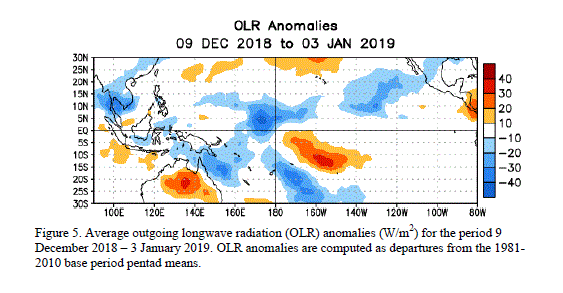
The Debts of the World: ENSO (El Nino Southern Oscillation) Update

As of Friday's close, forecasters remained skeptical of ENSO positive conditions but predictions released earlier in the week continued to dominate the tone of future predictions. In the end, it boils down to statistical (historic) modeling vs. dynamic (real time satellite) updates.

Synopsis: Conditions are favorable for a transition from ENSO-neutral to El Niño conditions during June - August 2009.

There continues to be considerable spread in the model forecasts for the Niño-3.4 region (Fig. 5). All statistical models predict ENSO-neutral conditions will continue for the remainder of 2009. However, most dynamical models, including the NCEP Climate Forecast System, predict the onset of El Niño during June - August 2009. Current observations, recent trends, and the dynamical model forecasts indicate that conditions are favorable for a transition from ENSO-neutral to El Niño conditions during June - August 2009.


http://www.cpc.ncep.noaa.gov/products/
analysis_monitoring/enso_advisory/ensodisc.html

Saturday, June 6, 2009

The Debts of the Spenders: A Tale of Two Markets - Corn, Meats, and Contango


Keep in mind the historical corn prices. Traders should exercise caution ahead. On one hand we have continued bullish momentum built into the weather. But on the other hand, we have contiued deflationary pressures on consumer consumption of meat.

Lingering concerns over the pig flu remain although I continue to believe that is an overreaction. Instead, the action in meats has been indicative of a more accurate macro-economic view of the ground level realities in the US.

Oh, one more thing to consider is that unlike oil, agriculture has NOT been in contango for months (e.g. big institutions storing supplies in tankers until the futures price exceeds spot). This means that the picture is not distorted by big funds pumping their positions for selfish gain (ahem...Government Sucks).


US Corn Crop Will Likely Not Meet Projected Levels - Study

The 2009 U.S. corn crop will likely be about 6.5% below projected levels because of late planting in key producing states, University of Illinois researchers said late Thursday.

In a report for the University of Illinois’s Department of Agricultural and Consumer Economics, researchers Scott Irwin, Darrel Good and Mike Tannura said under average summer weather conditions, the 2009 crop production could only be 11.3 billion bushels, with a yield of 148.6 bushels per acre. This is compared to the U.S. Department of Agriculture’s projected output of 12.09 billion bushels and yield of 155.4 bushels per acre from the May supply/demand report.

In 2008, corn production was 12.1 billion bushels, so the projected drop would be 6.6%.
The three researchers used Illinois, Indiana and Iowa in their study to project U.S. yields under three types of weather scenarios. These three states typically represent 40% of U.S. production and the researcher said crop weather forecasts have only been developed for these three states.

Excessive rain in the eastern corn belt has caused many planting delays, and about 30% of the U.S. acreage was planted after the optimal planting date of May 20. “The general lateness of planting and the large discrepancy in planting progress by region raises additional questions about the potential U.S. average corn yield in 2009,” the report said.

*******************************************************************
A soggy spring and widespread fundbuying continues to push Chicago Board of Trade corn futures to new highs, but some analysts say the market will eventually have to reckon with some bearish news on the demand side.

The livestock sector, which has been struggling for months due to the recession, has lately been getting even worse. The fallout will mean continuing weak feed demand for corn, likely through the end of 2009 if not longer, analysts said.

About 45% of the corn crop goes toward feed and residual use, according to the U.S. Department of Agriculture. Problems with the industry are the “canary in the mineshaft” that shows how
the recession could impact corn, said John Kleist, broker/analyst for Allendale.

The sector’s woes are widespread, from cattle to dairy cows to pork, and are directly tied to the recession, analysts said. Most recently Chicago Mercantile Exchange hog futures have been under intense pressure. Prices have dropped significantly, and agricultural lenders say they may have to force hog producers to either trim their herds or liquidate completely.